![An Australian Government Initiative [logo]](/images/austgovt_brown_90px.gif)



 Types
of fungal fruiting bodies (or sporocarps)
Types
of fungal fruiting bodies (or sporocarps)
Boletes & polypores
Boletes are fleshy and at first look like ordinary mushrooms. But look on the underside of the cap. Whereas a mushroom has gills, a bolete has a spongy layer of pores. The caps vary in diameter from just a couple of centimetres to a metre in some examples of Phlebopus marginatus, shown here.
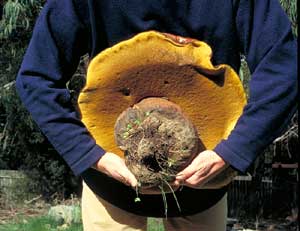 |
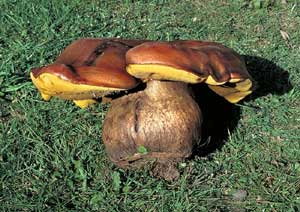 Phlebopus marginatus, left and above. |
Polypores mostly grow on dead or living wood and (apart from a few mushroom-shaped species) are anything from hoof-shaped to merely thin plates. While some are relatively soft, the majority are of tough consistency, from corky to rock-hard, with spore-releasing pores on their undersides. The non-mushroom-shaped species are attached to the wood by their edges and stick out like brackets. Most of the species are from one to 20 centimetres in diameter, but occasionally some species do grow to a metre or more.
 Polyporus arcularius |
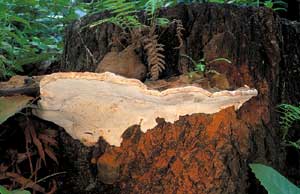 Ganoderma australe |
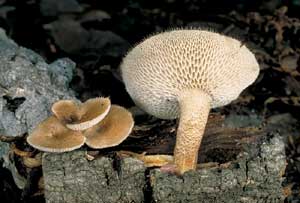
Polyporus arcularius is an example of a mushroom-shaped polypore, while Ganoderma australe shows the more common, bracket-like growth form. A few species have large pores, as in Polyporus arcularius, where they are very easy to see in an ordinary photograph. The fruiting body is about four centimetres in diameter.
On the other hand, to see the pores of Pycnoporus coccineus  you need to use a magnifying glass or a close-up lens on the camera.