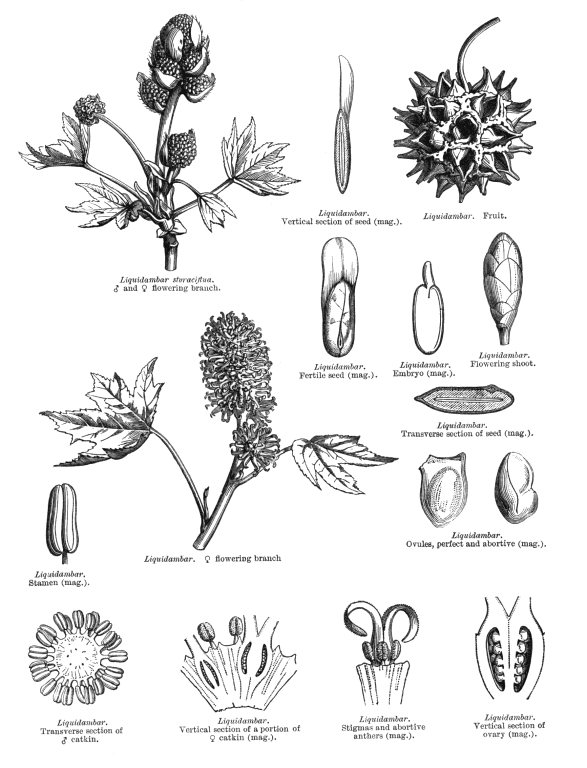
~ Hamamelidaceae (Altingioideae, Liquidambaroideae)
Including Balsamaceae Lindl., Liqidambaraceae Pfeiff.
Habit and leaf form. Trees (sometimes very large); resinous (ducts in axes and leaves). Leaves alternate; non-sheathing; simple. Lamina dissected; ovate; palmately lobed (or tricuspidate); pinnately veined, or palmately veined; cross-venulate. Leaves stipulate. Stipules intrapetiolar; caducous (small). Lamina margins entire (rarely), or serrate, or dentate. Domatia recorded (in Liquidambar); represented by pockets, or hair tufts.
Leaf anatomy. Stomata paracytic.
Adaxial hypodermis present.
Stem anatomy. Secretory cavities present. Cork cambium present; initially superficial. Cortical bundles absent. Medullary bundles absent. Internal phloem absent. Secondary thickening developing from a conventional cambial ring. `Included' phloem absent. Vessels without vestured pits. Wood parenchyma apotracheal (scarce).
Reproductive type, pollination. Monoecious (the male flower consisting of a globose stamen-cluster, enclosed in a bract). Gynoecium of male flowers absent.
Inflorescence, floral, fruit and seed morphology. Flowers aggregated in `inflorescences'. Inflorescences in terminal racemes (male), or in globular heads cf. Platanus (female).
Perianth sepaline, or vestigial; 0 (male flowers), or 12-50 (i.e. many, of minute lobes or scales, in female flowers); more or less accrescent (in female flowers).
Androecium 12-100 (i.e. `many' - the male inflorescences consisting terminal racemes of globose stamen-clusters); exclusively of fertile stamens. Stamens 12-50. Anthers basifixed; dehiscing via longitudinal slits (?), or dehiscing by londitudinal valves; tetrasporangiate. Endothecium developing fibrous thickenings. Microsporogenesis simultaneous. The initial microspore tetrads tetrahedral. Tapetum glandular. Pollen grains aperturate; polyaperturate; foraminate; 2-celled.
Gynoecium 2; syncarpous; synstylovarious; inferior. Ovary 2 locular. Stigmas 2; dry type; papillate; Group II type. Ovules 20-50 per locule; horizontal; anatropous; bitegmic; crassinucellate. Embryo-sac development Polygonum-type. Antipodal cells formed; 3; not proliferating; very ephemeral. Endosperm formation nuclear.
Fruit non-fleshy; dehiscent; a capsule. Capsules septicidal. Fruits from adjoining flowers aggregated into compound fruits. The fruit aggregates coalescing, or not coalescing (?). Dispersal unit the inflorescence (this globular, hard, dry, of many capsules). Cotyledons 2.
Physiology, biochemistry. Not cyanogenic. Iridoids recorded; carbocyclic. Proanthocyanidins present; cyanidin and delphinidin. Flavonols present; quercetin and myricetin. Ellagic acid present (Liquidambar). Arbutin absent.
Geography, cytology. Temperate to tropical. Asia Minor, temperate and tropical Southeast Asia, North and Central America. X = 8.
Taxonomy. Subclass Dicotyledonae; Crassinucelli. Dahlgren's Superorder Rosiflorae; Hamamelidales. Cronquist's Subclass Hamamelidae; Hamamelidales. Takhtajan's Subclass Hamamelidae; Hamamelidanae; Hamamelidales. Species 10. Genera 3; Altingia, Liquidambar, Semiliquidambar.
Economic uses, etc. Sources of timber.
Illustrations. altin411.gif