~ Orchidaceae.
Habit and leaf form. Leaves simple. Lamina entire; lanceolate; parallel-veined; without cross-venules. Vernation plicate.
General anatomy. Plants with silica bodies (these in idioblasts (stegmata) occurring along the fibres surrounding the vascular bundles).
Leaf anatomy. Epidermis without silica bodies. Stomata present; tetracytic, or anomocytic and tetracytic. Hairs absent.
The mesophyll containing calcium oxalate crystals. The mesophyll crystals raphides. Vessels absent.
Stem anatomy. Primary vascular tissue in scattered bundles; centrifugal. Secondary thickening absent. Xylem without vessels.
Root anatomy. Roots with velamen. Root xylem with vessels. Vessel end-walls scalariform and simple (mainly simple).
Reproductive type, pollination. Hermaphrodite.
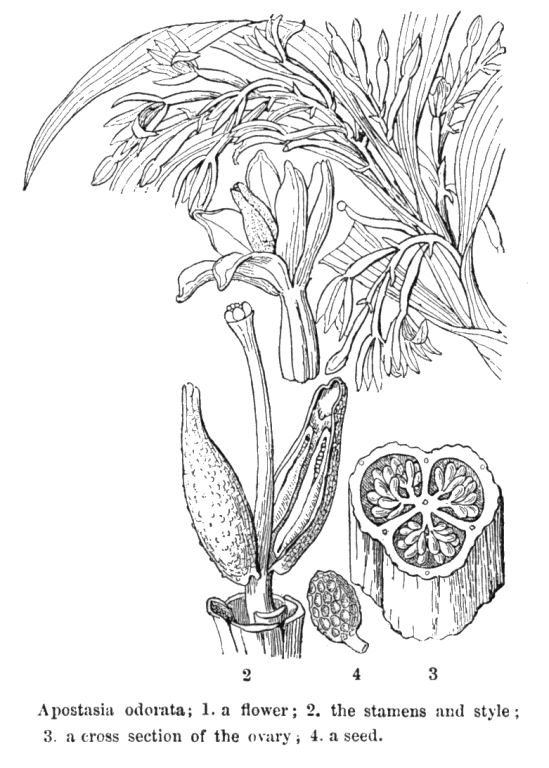
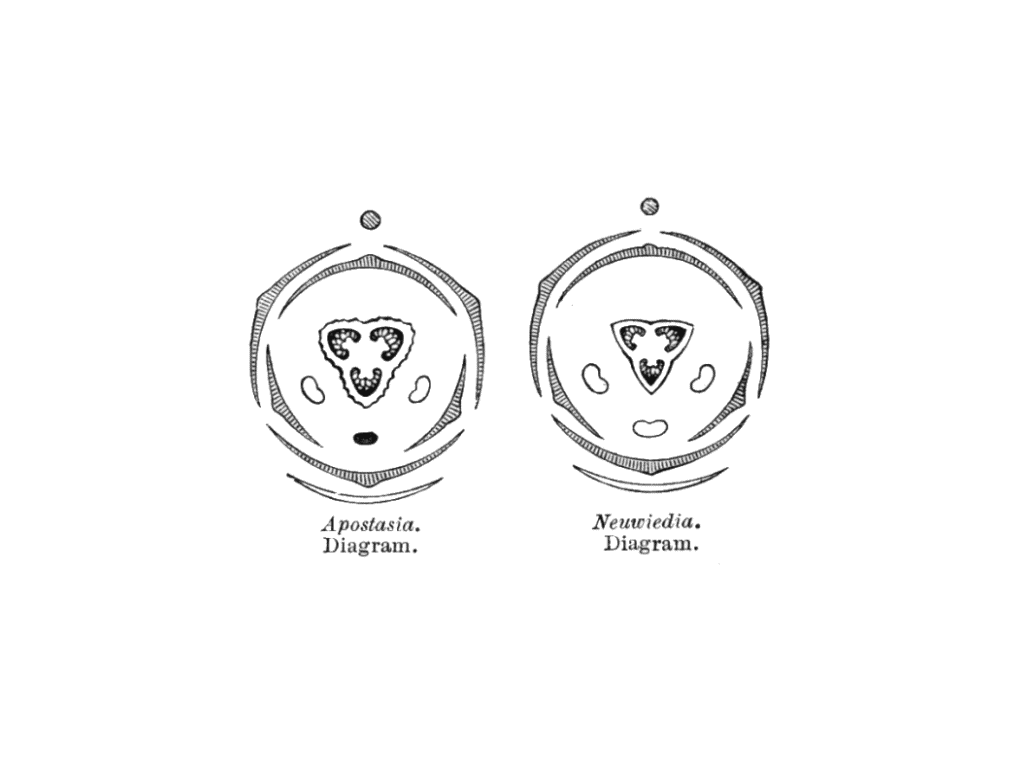
Inflorescence, floral, fruit and seed morphology. Flowers aggregated in `inflorescences'. The terminal inflorescence unit racemose. Inflorescences scapiflorous; racemes, sometimes branched. Flowers somewhat irregular; more or less zygomorphic; resupinate (Neuwiedia), or not resupinate (Apostasia). The floral asymmetry involving the perianth and involving the androecium (more consistently the latter). Flowers 3 merous; cyclic; supposedly basically pentacyclic. Perigone tube absent.
Perianth of `tepals'; 6 (3+3); free; 2 whorled (the median inner member sometimes larger, forming a labellum); isomerous; petaloid; white, or yellow.
Androecium 2-3 (the median of the outer whorl, which is sometimes missing, and the two laterals of the inner whorl). Androecial members free of the perianth; partially united with the gynoecium; coherent (at the base, and with the style); theoretically 2 - whorled, or 1 - whorled. Androecium exclusively of fertile stamens, or including staminodes. Staminodes when present, 1 (the median member). Stamens 2, or 3; isomerous with the perianth; al\ter\ni\peri\anthial (when the median of the outer whorl is present), or op\po\siti\peri\anthial (when only the two laterals of the inner whorl are present); filantherous to with sessile anthers. Anthers dorsifixed to basifixed; dehiscing via longitudinal slits; introrse. The thickenings spiral. Microsporogenesis simultaneous. Pollen shed as single grains. Pollen grains aperturate; 1 - aperturate; sulcate (operculate).
Gynoecium 3. Carpels isomerous with the perianth. Gynoecium syncarpous; eu-syncarpous; inferior. Ovary 3 locular. The `odd' carpel anterior. Styles 1. Stigmas 1; 2-3 - lobed; capitate. Placentation axile. Ovules 10-50 per locule (i.e. `many'); anatropous.
Fruit fleshy, or non-fleshy; indehiscent (disintegrating, usually), or dehiscent; a capsule. Capsules when dehiscent, loculicidal (Neuwiedia). Fruit 30-100 seeded (`many'). Seeds minute. Embryo rudimentary at the time of seed release, or weakly differentiated.
Geography, cytology. Tropical. S.E. Asia, Indomalaya, tropical Australia.
Taxonomy. Subclass Monocotyledonae. Superorder Liliiflorae; Orchidales. Species 20. Genera 3; Apostasia, Adactylus, Neuwiedia.
Illustrations. apost184.gif apost777.gif