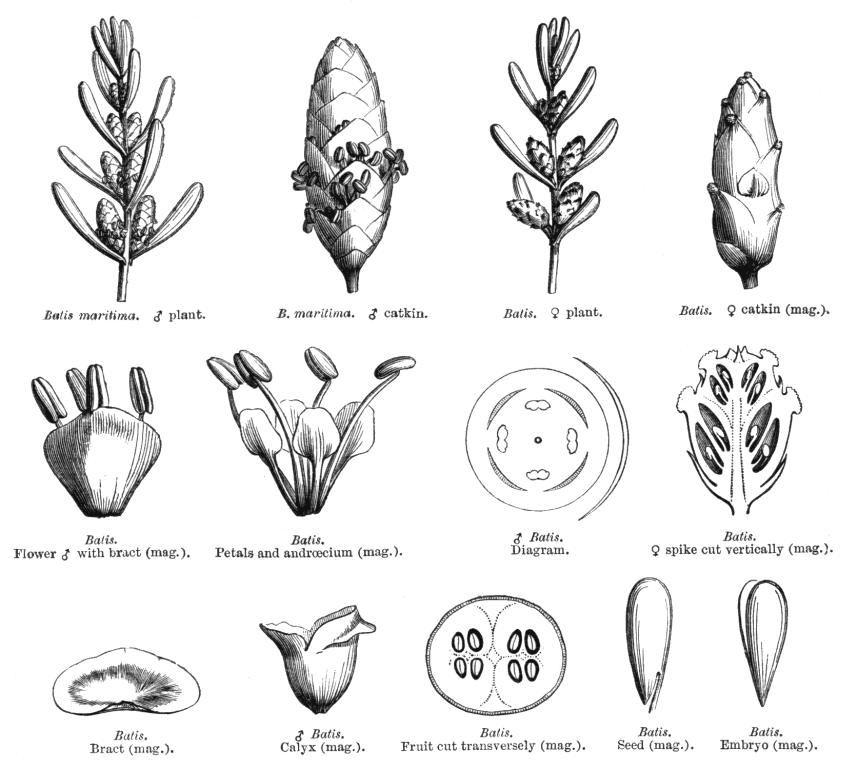
Alternatively Batidaceae
Habit and leaf form. Weak, straggling coastal shrubs (to 150 cm high). Plants succulent. Xerophytic. Leaves small; opposite; flat, or terete (flat above, convex below); fleshy; subsessile to sessile; strong-scented; simple. Lamina entire; linear, or oblong, or obovate. Leaves exstipulate. Vegetative buds not scaly.
Leaf anatomy. Stomata paracytic.
Stem anatomy. Young stems tetragonal. Cork cambium present; initially deep-seated (inside the bundles of pericyclic fibres). Internal phloem absent. Secondary thickening absent, or developing from a conventional cambial ring (?). `Included' phloem absent. Vessel end-walls horizontal to oblique; simple. Wood partially storied (VPI). Sieve-tube plastids S-type.
Reproductive type, pollination. Monoecious, or dioecious. Gynoecium of male flowers vestigial, or absent.
Inflorescence, floral, fruit and seed morphology. Flowers aggregated in `inflorescences'; in spikes. The terminal inflorescence unit racemose. Inflorescences axillary; conical, strobiloid spikes with flowers in four ranks. Flowers bracteate (the bracts cochleariform and imbricate in male inflorescences, smaller and partially incorporated in the fleshy female spike); small; those of of male plants somewhat irregular to very irregular; male flowers zygomorphic. The floral asymmetry of male flowers involving the perianth. Flowers (male) 4 merous; male flowers cyclic. Free hypanthium absent. Hypogynous disk absent.
Perianth with distinct calyx and corolla (in male flowers), or absent (in female flowers, where the lower bracts are united); of male flowers 2 whorled. Calyx of male flowers 1 whorled; gamosepalous; lobed; cupuliform, or campanulate; bilabiate. Corolla of male flowers 4; 1 whorled; polypetalous, or gamopetalous (the claws more or less united); regular. Petals clawed.
Androecium of male flowers 4. Androecial members free of the perianth; all equal; free of one another; 1 - whorled. Androecium exclusively of fertile stamens. Stamens 4; isomerous with the perianth; oppositisepalous (at least, alternating with the corolla). Anthers dorsifixed; versatile; dehiscing via longitudinal slits; introrse; tetrasporangiate; briefly appendaged. The anther appendages apical (by short extension of the connective). Endothecium developing fibrous thickenings. Anther wall initially with more than one middle layer. Pollen grains aperturate; 3(-4) - aperturate; colporate, or rugate (colporoidate or ruporoidate); 2-celled.
Gynoecium of female flowers 2 (but secondarily partitioned from each carpel midrib); syncarpous; synstylovarious to eu-syncarpous; superior (but the 8-10 gynoecia of adjoining flowers coherent, and adherent to the bract bases). Ovary 4 locular; sessile. Gynoecium non-stylate. Stigmas 2 (sessile). Placentation basal. Ovules 1 per locule; funicled; ascending; anatropous.
Fruit fleshy; indehiscent; a drupe (with four pyrenes). Fruits from adjoining flowers aggregated into compound fruits. The fruit aggregates coalescing. Seeds non-endospermic. Embryo well differentiated. Cotyledons 2. Embryo straight.
Seedling. Germination phanerocotylar.
Physiology, biochemistry. Mustard-oils present. Not cyanogenic. Alkaloids absent (one species). Iridoids absent. Proanthocyanidins absent. Ellagic acid absent. Betalains absent. C3. C3 recorded in Batis.
Geography, cytology. Paleotropical, Neotropical, and Australian. Tropical. Pacific, West Indies, north coastal South America, central America to Florida, New Guinea, Queensland. N = 9.
Taxonomy. Subclass Dicotyledonae; Crassinucelli. Dahlgren's Superorder Violiflorae (? - or Caryophylliflorae); Capparales. Cronquist's Subclass Dilleniidae; Batales. Takhtajan's Subclass Rosidae; Rutanae; Sapindales. Species 2. Genera 1; only genus, Batis.
Illustrations. batac738.gif