~ Euphorbiaceae
Habit and leaf form. Large trees. Leaves deciduous; alternate; petiolate; compound; ternate, or pinnate (3(-5) foliolate). Lamina pinnately veined; cross-venulate. Leaves stipulate. Stipules scaly (membranous); caducous.
Stem anatomy. Vessel end-walls scalariform and simple.
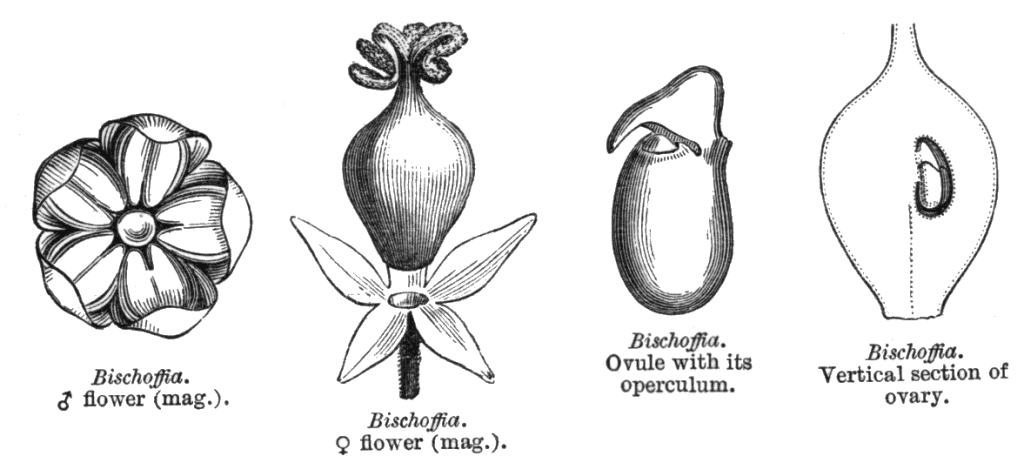
Reproductive type, pollination. Monoecious (rarely), or dioecious. The female flowers with or without minute staminodes. Gynoecium of male flowers in the form of a broad, peltate, shortly stipitate pistillode.
Inflorescence, floral, fruit and seed morphology. Flowers aggregated in `inflorescences'. The terminal inflorescence unit cymose. Inflorescences axillary; many flowered thyrses. Flowers small. Free hypanthium absent. Hypogynous disk absent.
Perianth sepaline (corolla lacking); 5; 1 whorled. Calyx 5; 1 whorled; polysepalous; imbricate (in female flowers), or valvate (induplicate, in male flowers).
Androecium 5. Androecial members free of the perianth; free of one another; 1 - whorled. Androecium exclusively of fertile stamens. Stamens 5; isomerous with the perianth; oppositisepalous (and enclosed by them); very shortly filantherous (the anthers large). Anthers introrse.
Gynoecium 3. Carpels reduced in number relative to the perianth. Gynoecium syncarpous; synstylovarious; superior. Ovary 3 locular. Gynoecium stylate. Styles 1 (short); apical. Stigmas 3 (these elongate, linear-subulate, spreading or reflexed). Ovules 2 per locule; pendulous.
Fruit fleshy; indehiscent; a drupe (small, globose, with horny endocarp); 3-6 seeded. Seeds endospermic.
Geography, cytology. Holarctic and Paleotropical. Tropical. Tropical Asia.
Taxonomy. Subclass Dicotyledonae; Crassinucelli. Dahlgren's Superorder Malviflorae; Euphorbiales. Cronquist's Subclass Rosidae; Euphorbiales. Takhtajan's Subclass Dilleniidae; Malvanae; Euphorbiales. Species 2. Genera 1; only genus, Bischofia.
Illustrations. bisch690.gif