Including Boöpidaceae Cass.
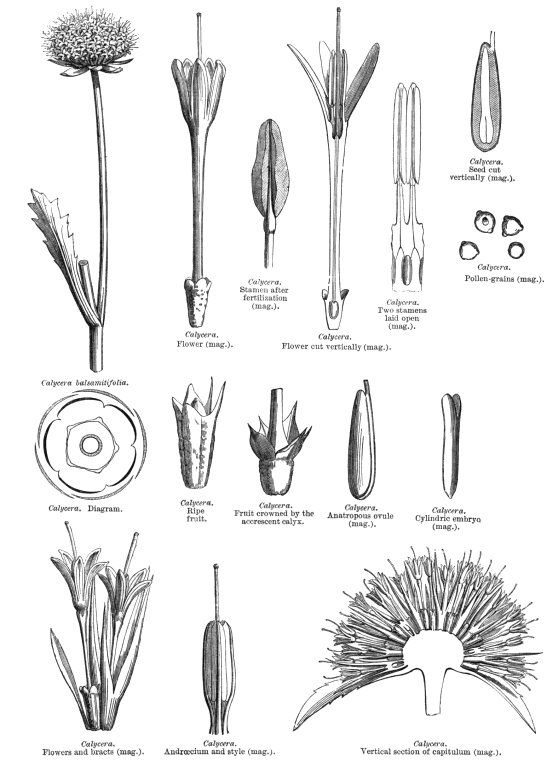
Habit and leaf form. Herbs. Annual to perennial; with a basal aggregation of leaves, or with neither basal nor terminal aggregations of leaves. Leaves alternate; simple. Lamina dissected, or entire; when dissected, pinnatifid (pinnately lobed). Leaves exstipulate.
Leaf anatomy. Stomata present; on both surfaces; anomocytic.
Lamina without secretory cavities.
Stem anatomy. Secretory cavities absent. Secondary thickening absent, or developing from a conventional cambial ring (?). Vessel end-walls simple.
Reproductive type, pollination. Hermaphrodite (usually), or monoecious, or andromonoecious, or gynomonoecious. Entomophilous. Pollination mechanism conspicuously specialized (the pollen released into an anther tube, and pushed out by elongation of the style).
Inflorescence, floral, fruit and seed morphology. Flowers aggregated in `inflorescences'; in heads. The terminal inflorescence unit racemose (the capitula centripetal). Inflorescences scapiflorous, or not scapiflorous; consisting of involucrate, centripetally flowering heads; with involucral bracts; pseudanthial. Flowers bracteate (the capitulum surrounded by 1-2 series); regular, or somewhat irregular; more or less zygomorphic. The floral asymmetry involving the perianth (the corolla). Flowers (4-)5(-6) merous; cyclic; tetracyclic. Free hypanthium absent.
Perianth with distinct calyx and corolla; (8-)10(-12); 2 whorled; isomerous. Calyx (4-)5(-6); 1 whorled; polysepalous, or gamosepalous; lobulate, or lobed, or toothed; unequal but not bilabiate, or regular; persistent; accrescent, or non-accrescent. Corolla (4-)5(-6); 1 whorled; gamopetalous; valvate, or with open aestivation; somewhat unequal but not bilabiate, or regular; persistent.
Androecium (4-)5(-6). Androecial members adnate (neat the top of the corolla tube); coherent (the filaments connate into a tube, at least basally); 1 - adelphous; 1 - whorled. Androecium exclusively of fertile stamens. Stamens (4-)5(-6); isomerous with the perianth; oppositisepalous. Anthers connivent, or cohering (sometimes, basally); basifixed; non-versatile; dehiscing via longitudinal slits; introrse; tetrasporangiate. Endothecium developing fibrous thickenings. Anther epidermis degenerating. Tapetum glandular. Pollen grains aperturate; 3 - aperturate; colporate; 2-celled.
Gynoecium basically 2. Carpels reduced in number relative to the perianth. Gynoecium syncarpous (but pseudomonomerous); eu-syncarpous; inferior. Ovary 1 locular. Epigynous disk present (uniting the base of the corolla to the style, lining the corolla tube and dilating into glandular areolae). Gynoecium stylate. Styles 1; apical. Stigmas 1; capitate. Placentation apical. Ovules in the single cavity 1; pendulous; non-arillate; anatropous; unitegmic; tenuinucellate. Embryo-sac development Polygonum-type. Polar nuclei fusing prior to fertilization. Antipodal cells formed; 3; not proliferating; ephemeral. Synergids elongated, with slender beaks. Endosperm formation cellular.
Fruit non-fleshy; indehiscent; achene-like (crowned by the persistent calyx and corolla). Fruits from adjoining flowers aggregated into compound fruits (often, more or less), or not aggregated into compound fruits. The fruit aggregates coalescing (sometimes, somewhat), or not coalescing. Fruit 1 seeded. Seeds copiously or scantily endospermic. Endosperm oily. Embryo well differentiated. Cotyledons 2. Embryo straight.
Physiology, biochemistry. Not cyanogenic. Iridoids recorded; seco-compounds. Proanthocyanidins absent. Aluminium accumulation not found. Inulin recorded.
Geography, cytology. Neotropical. Temperate to sub-tropical. South America. X = 8, 15, 18, 21.
Taxonomy. Subclass Dicotyledonae; Tenuinucelli. Dahlgren's Superorder Corniflorae; Dipsacales. Cronquist's Subclass Asteridae; Calycerales. Takhtajan's Subclass Asteridae; Asteranae; Calycerales. Species 40. Genera 6; Acicarpha, Boöpis, Calycera, Gamocarpha, Moschopsis, Nastanthus.
Illustrations. calyc492.gif