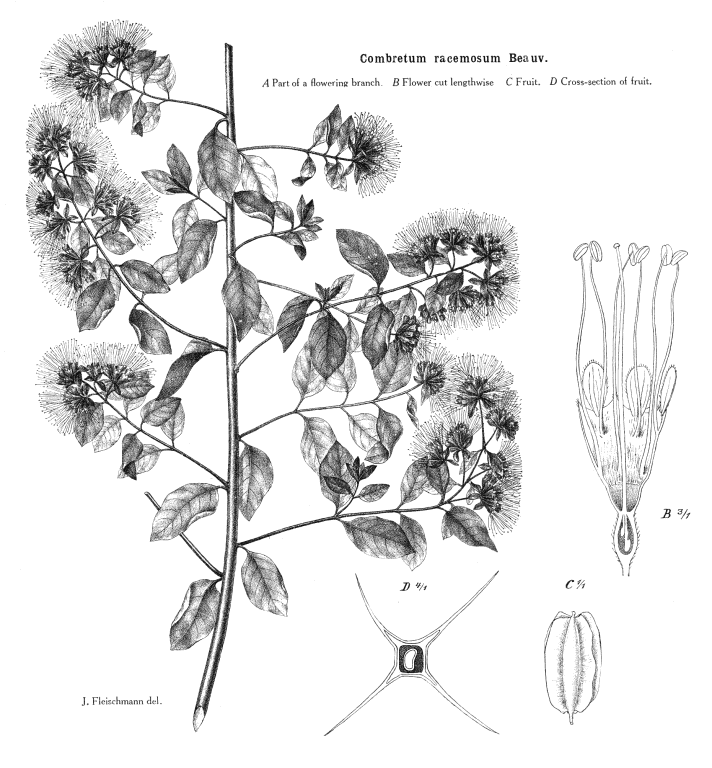
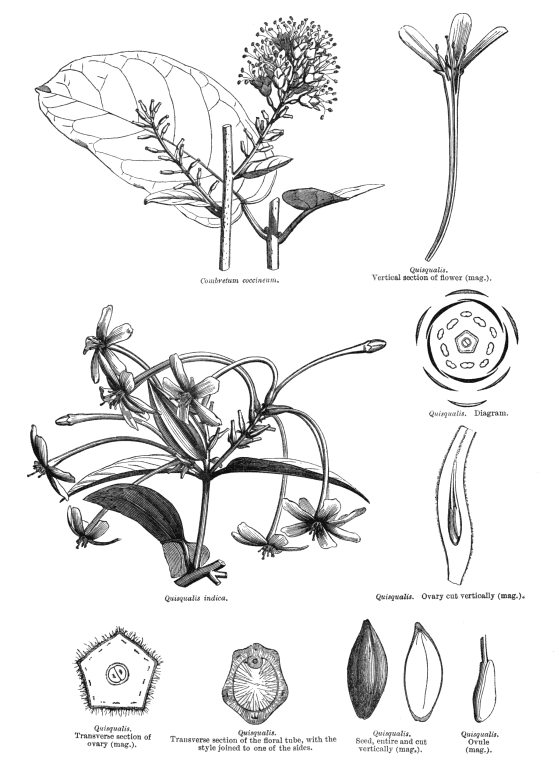
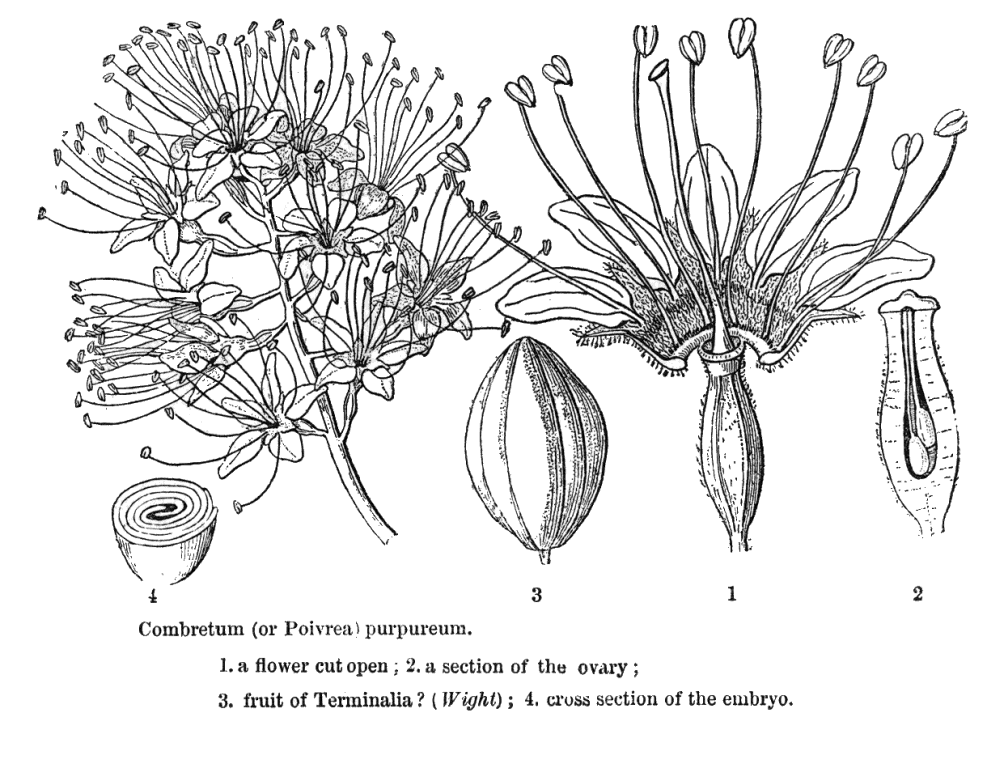
Including Shae(ace)ae Bertol. f., Strephonemataceae (Benth. & Hook. f.) Venkat. & Prak. Rao, Terminaliaceae Jaume St.-Hil.
Habit and leaf form. Trees, or shrubs, or lianas. Self supporting, or climbing (commonly); when climbing, stem twiners, or scrambling (via hooks representing persistent petiole bases). Mesophytic to xerophytic (often in savanna), or helophytic. Leaves alternate, or opposite, or whorled (rarely); spiral, or distichous, or four-ranked; non-sheathing; gland-dotted, or not gland-dotted; simple. Lamina entire; pinnately veined; cross-venulate. Leaves minutely stipulate, or exstipulate. Lamina margins entire. Leaves without a persistent basal meristem. Domatia recorded (from 11 genera and numerous species); represented by pits, or pockets, or hair tufts (mostly).
Leaf anatomy. Hydathodes present (occasionally), or absent.
Lamina dorsiventral (usually), or centric (rarely); with secretory cavities, or without secretory cavities. Secretory cavities containing mucilage. Minor leaf veins without phloem transfer cells (Combretum).
Stem anatomy. Secretory cavities present, or absent; with mucilage. Cork cambium present; initially deep-seated, or superficial. Nodes unilacunar. Internal phloem present, or absent. Secondary thickening developing from a conventional cambial ring, or anomalous; from a single cambial ring. `Included' phloem present (commonly), or absent. Xylem with fibre tracheids; with libriform fibres, or without libriform fibres. Vessel end-walls horizontal to oblique; simple. Vessels with vestured pits (usually), or without vestured pits. Wood parenchyma predominantly paratracheal.
Reproductive type, pollination. Hermaphrodite, or andromonoecious; plants viviparous (in the mangroves), or not viviparous.
Inflorescence, floral, fruit and seed morphology. Flowers aggregated in `inflorescences'; in racemes, in spikes, and in heads. The terminal inflorescence unit usually racemose. Inflorescences usually racemose. Flowers usually small; regular; 3-8 merous; cyclic; tetracyclic, or pentacyclic. Free hypanthium present.
Perianth with distinct calyx and corolla, or sepaline (the corolla sometimes absent); 4-5, or 9-10(-16); 1 whorled, or 2 whorled; isomerous. Calyx 4-5(-8); 1 whorled; gamosepalous (as lobes from the hypanthium); regular; persistent; imbricate, or valvate (or very small). Corolla when present, 4-5(-8); 1 whorled; polypetalous; when present, imbricate, or valvate; regular.
Androecium often 10 (commonly twice K), or 5 (sometimes outer whorl missing), or 10-100 (rarely `many). Androecial members free of the perianth; all equal; free of one another (usually), or coherent (rarely grouped); 2 - whorled (usually), or 1 - whorled (sometimes the outer missing), or 3 - whorled (rarely). Androecium exclusively of fertile stamens. Stamens 5, or 10, or 11-30; isomerous with the perianth, or diplostemonous (commonly), or polystemonous; oppositisepalous. Anthers dorsifixed; versatile; dehiscing via longitudinal slits; tetrasporangiate. Endothecium developing fibrous thickenings. Microsporogenesis simultaneous. The initial microspore tetrads tetrahedral, or isobilateral. Anther wall initially with one middle layer (Guiera), or initially with more than one middle layer (usually); usually of the `basic' type (Guiera). Tapetum glandular. Pollen grains aperturate; 3 - aperturate; colporate; 2-celled.
Gynoecium 2-5; syncarpous; synstylovarious, or eu-syncarpous; inferior. Ovary 1 locular. Epigynous disk present. Styles 1. Stigmas wet type; non-papillate; Group IV type. Placentation apical. Ovules in the single cavity 2-5(-6); pendulous; non-arillate; anatropous; bitegmic; crassinucellate. Outer integument contributing to the micropyle. Embryo-sac development Polygonum-type, or Penaea-type. Polar nuclei fusing prior to fertilization. Antipodal cells formed; 3; proliferating (somewhat, in Guiera), or not proliferating. Synergids hooked (sometimes with filiform apparatus). Endosperm formation nuclear. Embryogeny asterad.
Fruit fleshy, or non-fleshy; indehiscent (usually), or a schizocarp; when schizocarpic, comprising mericarps; usually a drupe. Dispersal often by water, by animals or by wind (the wind-dispersed forms winged). Seeds non-endospermic. Embryo well differentiated (the cotyledons usually convolute, sometimes folded, sometimes massive and hemispherical). Cotyledons 1 (by concrescence), or 2, or 3 (folded or twisted, rarely hemispherical). Embryo chlorophyllous (2/2), or achlorophyllous (1/1).
Seedling. Germination phanerocotylar, or cryptocotylar.
Physiology, biochemistry. Cyanogenic (?), or not cyanogenic. Alkaloids present, or absent (mostly). Iridoids absent. Proanthocyanidins present, or absent; when present, cyanidin. Flavonols present, or absent; kaempferol, or kaempferol and quercetin, or kaempferol, quercetin, and myricetin. Ellagic acid present (3 genera, 4 species). Saponins/sapogenins absent. Aluminium accumulation not found. Sugars transported as oligosaccharides + sucrose. Anatomy non-C4 type (Lumnitzera, Terminalia).
Geography, cytology. Sub-tropical and tropical. Widespread. X = 7, 11-13.
Taxonomy. Subclass Dicotyledonae; Crassinucelli. Dahlgren's Superorder Myrtiflorae; Myrtales. Cronquist's Subclass Rosidae; Myrtales. Takhtajan's Subclass Rosidae; Myrtanae; Myrtales. Species 600. Genera about 20; Anogeissus, Buchenavia, Bucida, Calopyxis, Calycopteris, Combretum, Conocarpus, Dansiea, Guiera, Laguncularia, Lumnitzera, Macropteranthes, Melostemon, Pteleopsis, Quisqualis, Strephonema, Terminalia, Terminaliopsis, Thiloa.
Illustrations. combr390.gif combr420.gif combr717.gif
Additional, to be intercalated. Combretum twining anticlockwise.