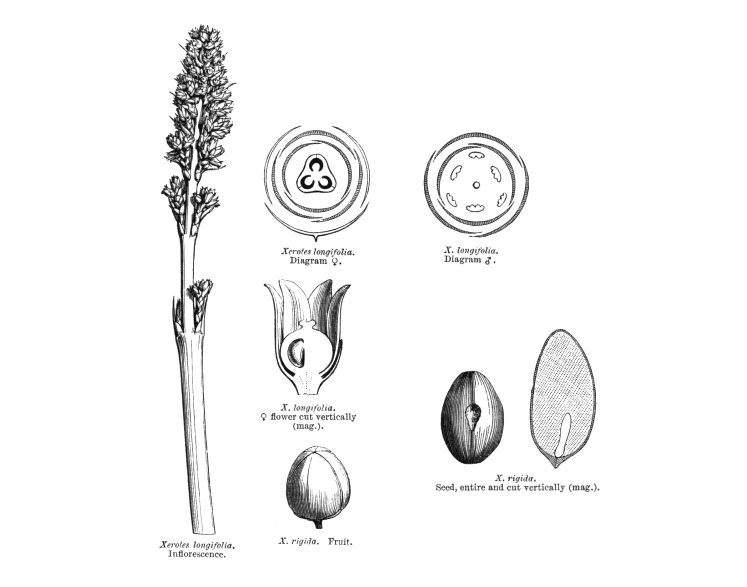
~ Xanthorrhoeaceae
Including Lomandraceae
Habit and leaf form. `Arborescent', or shrubs, or herbs (less often). With a basal aggregation of leaves (more or less acaulescent), or with neither basal nor terminal aggregations of leaves; rhizomatous. Pachycaul. Mesophytic, or xerophytic. Leaves small to large; alternate; spiral (usually), or distichous; leathery, or modified into spines, or `herbaceous'; sessile; sheathing. Leaf sheaths not tubular; with free margins. Leaves simple. Lamina entire; acicular, or linear; parallel-veined; without cross-venules.
Leaf anatomy. Stomata present; anomocytic.
The mesophyll containing calcium oxalate crystals, or without calcium oxalate crystals (?). The mesophyll crystals raphides (Lomandra), or druses (?), or solitary-prismatic (?). Minor leaf veins without phloem transfer cells (Lomandra). Vessels present (Acanthocarpos), or absent; end-walls scalariform.
Stem anatomy. Primary vascular tissue in scattered bundles. Secondary thickening absent, or anomalous (and sometimes with compound vascular bundles); from a single cambial ring. Xylem without vessels.
Root anatomy. Root xylem with vessels. Vessel end-walls scalariform, or simple.
Reproductive type, pollination. Hermaphrodite, or dioecious.
Inflorescence, floral, fruit and seed morphology. Flowers aggregated in `inflorescences'. Inflorescences scapiflorous, or not scapiflorous; elongate and loosely branched, or of globose partial inflorescences, or of dense, multiflorous often globose paniculate or thyrsoid heads. Flowers small; regular; 3 merous; cyclic; pentacyclic. Perigone tube present, or absent. Hypogynous disk absent.
Perianth of `tepals'; 6; free, or joined; 2 whorled; isomerous; sepaloid (occasionally), or petaloid (usually); similar in the two whorls, or different in the two whorls; white, or cream, or yellow, or hyaline; fleshy, or non-fleshy.
Androecium 6. Androecial members free of the perianth, or free of the perianth and adnate (the three inner members sometimes fused to the bases of the inner tepals); all equal; free of one another; 2 - whorled. Androecium exclusively of fertile stamens. Stamens 6; diplostemonous. Anthers dorsifixed to basifixed; dehiscing via longitudinal slits; introrse. The thickenings spiral, or girdling (Lomandra). Pollen shed as single grains. Pollen grains aperturate; 1 - aperturate, or 2 - aperturate, or 3-9 - aperturate (to `many'); sulcate, or sulculate, or zoniaperturate, or annulosulcate, or foraminate.
Gynoecium 3. Carpels isomerous with the perianth. Gynoecium syncarpous; eu-syncarpous; superior, or inferior. Ovary 1 locular (Dasypogon), or 3 locular. Gynoecium stylate. Styles 1 (simple or tribrachiate); attenuate from the ovary, or from a depression at the top of the ovary; apical. Stigmas 1, or 3; 1 - lobed, or 3 - lobed; wet type. Placentation when unilocular, basal; when trilocular, axile. Ovules in the single cavity when unilocular, 1; 1 per locule; non-arillate; anatropous to campylotropous; crassinucellate. Embryo-sac development Polygonum-type. Polar nuclei fusing prior to fertilization. Antipodal cells formed; 3 (large); not proliferating. Synergids pear-shaped (with filiform apparatus).
Fruit non-fleshy; dehiscent, or indehiscent; a capsule, or capsular-indehiscent. Seeds endospermic. Embryo well differentiated (but often small). Testa without phytomelan (always?).
Physiology, biochemistry. Not cyanogenic. Proanthocyanidins absent. Flavonols absent. Ellagic acid absent.
Geography, cytology. Paleotropical and Australian. Australian, with Lomandra extending to New Guinea and New Caledonia. X = 7,8, 9.
Taxonomy. Subclass Monocotyledonae. Superorder Liliiflorae; Asparagales. Species about 65. Genera 8; Acanthocarpus, Baxteria, Chamaexeros, Dasypogon, Kingia, Lomandra, Romnalda, Xerolirion.
Illustrations. loman862.gif