~ Haloragidaceae
Habit and leaf form. Herbs. Perennial; with a basal aggregation of leaves (the leaves all radical). Often pachycaul. Helophytic, or mesophytic. Leaves medium-sized to very large (rhubarb-like); alternate; strongly petiolate; sheathing; simple; often peltate; epulvinate. Lamina dissected to entire; ovate, or obovate; often more or less palmately lobed; palmately veined; often cordate, or cuneate at the base. Leaves ligulate, or eligulate (depending on interpretation - there often being axillary rows of ligular or stipular `intravaginal scales'); stipulate, or exstipulate (in Australia, or always, depending on interpretation of the `ligule'). Stipules if interpreted as such, intrapetiolar; free of one another, or concrescent; ochreate, or not ochreate; scaly. Lamina margins entire, or serrate, or dentate. Leaves without a persistent basal meristem.
Leaf anatomy. Stomata anomocytic.
Lamina without secretory cavities. Minor leaf veins without phloem transfer cells (1 genus).
Stem anatomy. Secretory cavities absent. Secondary thickening absent (the stem ostensibly polystelic). Xylem with vessels. Vessel end-walls simple. Sieve-tube plastids P-type; type I (b).
Reproductive type, pollination. Monoecious, or dioecious, or polygamomonoecious.
Inflorescence, floral, fruit and seed morphology. Flowers aggregated in `inflorescences'; in panicles, in racemes, and in spikes. Inflorescences scapiflorous; pseudo- terminal, or axillary. Flowers ebracteate; bracteolate; minute to small; 2(-3) merous; cyclic; tricyclic, or tetracyclic. Free hypanthium absent.
Perianth with distinct calyx and corolla, or sepaline (C sometimes lacking especially in female flowers, K sometimes very small); when present, 2-5; 1 whorled, or 2 whorled; isomerous, or anisomerous. Calyx 2(-3) (small or sometimes `almost lacking'); 1 whorled; polysepalous; valvate. Corolla when present, 2; 1 whorled; polypetalous.
Androecium (1-)2. Androecial members adnate (epipetalous), or free of the perianth; all equal; free of one another; 1 - whorled. Androecium exclusively of fertile stamens. Stamens 1, or 2; reduced in number relative to the adjacent perianth to isomerous with the perianth; alternisepalous. Anthers dehiscing via longitudinal slits; tetrasporangiate. Endothecium developing fibrous thickenings. Microsporogenesis simultaneous. Anther wall initially with one middle layer; of the `monocot' type. Tapetum glandular. Pollen grains aperturate; 3(-5) - aperturate; colpate; 2-celled.
Gynoecium 2; syncarpous; synovarious; inferior. Ovary 1 locular. Styles 2; free; apical. Stigmas dry type; papillate; Group II type. Placentation apical. Ovules in the single cavity 1; pendulous; non-arillate; anatropous; bitegmic; crassinucellate. Outer integument contributing to the micropyle. Embryo-sac development Peperomia-type. Polar nuclei fusing prior to fertilization. Antipodal cells formed; 6; not proliferating; ephemeral. Endosperm formation cellular.
Fruit fleshy to non-fleshy; indehiscent; a drupe, or a nut. Seeds copiously endospermic. Endosperm oily. Embryo well differentiated (very small). Cotyledons 2. Embryo curved to bent (obcordate).
Physiology, biochemistry. Not cyanogenic. Iridoids absent. Proanthocyanidins absent. Flavonols present; kaempferol and quercetin. Ellagic acid present.
Geography, cytology. Temperate to tropical. Tropical and southern temperate. X = 11, 12, 17, 18.
Taxonomy. Subclass Dicotyledonae; Crassinucelli. Dahlgren's Superorder Rosiflorae; Gunnerales. Cronquist's Subclass Rosidae; Haloragales. Takhtajan's Subclass Rosidae; Rosanae; Saxifragales (?). Species 50. Genera 1; only genus, Gunnera.
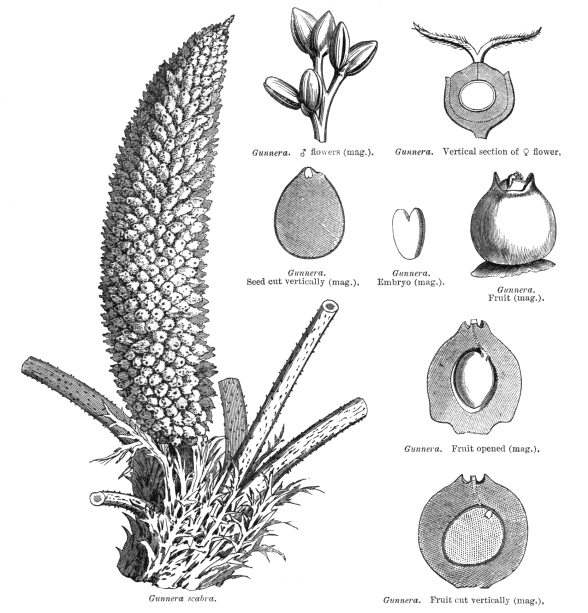
Illustrations. gunne416.gif