~ Linaceae
Excluding Ctenolophonaceae
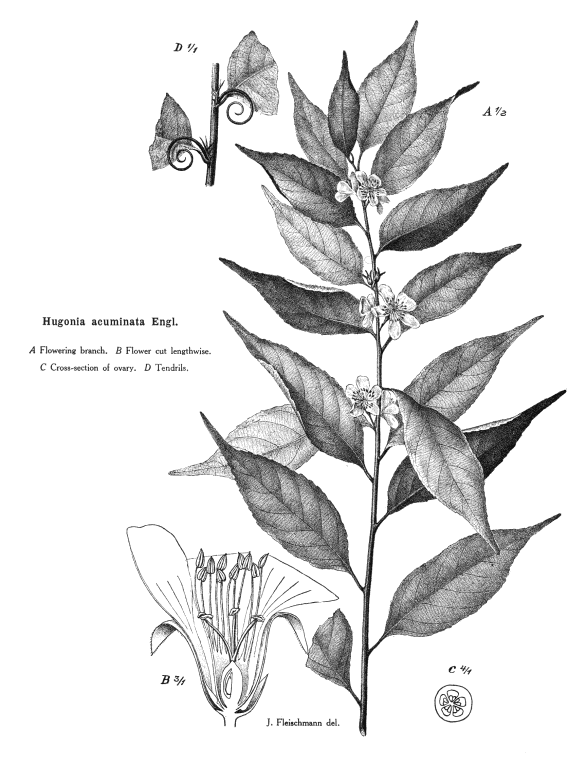
Habit and leaf form. Lianas. Climbing; scrambling (the lower inflorescence branches modified into hooks). Leaves alternate; simple. Lamina entire. Leaves stipulate. Stipules caducous.
Leaf anatomy. Mucilaginous epidermis present. Stomata present; paracytic.
Lamina dorsiventral. The mesophyll with sclerencymatous idioblasts.
Stem anatomy. Nodes tri-lacunar. Secondary thickening developing from a conventional cambial ring. Vessel end-walls scalariform and simple, or scalariform, or simple. Wood parenchyma apotracheal (confluent).
Reproductive type, pollination. Hermaphrodite.
Inflorescence, floral, fruit and seed morphology. Flowers aggregated in `inflorescences'; in racemes, or in spikes, or in panicles. Inflorescences terminal, or axillary. Flowers small to large; somewhat irregular, or very irregular. The floral asymmetry involving the perianth (the calyx only), or involving the androecium. Flowers 5 merous. Free hypanthium absent. Hypogynous disk present; extrastaminal; of separate members (represented by 2-5 glands).
Perianth with distinct calyx and corolla; 10; 2 whorled; isomerous. Calyx 5; 1 whorled; polysepalous (the sepals commonly more or less unequal); imbricate. Corolla 5; 1 whorled; polypetalous; contorted; regular; deciduous (fugacious).
Androecium 10, or 15. Androecial members free of the perianth; usually markedly unequal; coherent (the filaments connate for much of their length, forming a tube); 1 - adelphous. Androecium exclusively of fertile stamens, or including staminodes (? - the extrastaminal glands). Staminodes (the glands) 2-5. Stamens 10, or 15; diplostemonous, or triplostemonous. Anthers dehiscing via longitudinal slits. Pollen shed as single grains. Pollen grains aperturate; 3 - aperturate; colporate.
Gynoecium 2-5. Carpels reduced in number relative to the perianth to isomerous with the perianth. Gynoecium syncarpous; synovarious, or synstylovarious; superior. Ovary 2-5 locular (sometimes with the partitions not quite reaching the summit, without false partitions). Gynoecium stylate. Styles 1, or 2-5; free, or partially joined. Placentation axile to apical. Ovules 2 per locule; pendulous; epitropous; with ventral raphe (the micropyle directed upwards and outwards); with a placental obturator; anatropous; bitegmic; crassinucellate.
Fruit fleshy; indehiscent; a drupe. Seeds scantily endospermic, or non-endospermic. Embryo well differentiated. Cotyledons 2. Embryo slightly curved, or straight.
Physiology, biochemistry. Saponins/sapogenins present.
Geography, cytology. Paleotropical. Sub-tropical to tropical. Tropical Africa, Madagascar, Indomalaysia, New Caledonia. X = 12, 13.
Taxonomy. Subclass Dicotyledonae; Crassinucelli. Dahlgren's Superorder Rutiflorae; Geraniales. Cronquist's Subclass Rosidae; Linales. Takhtajan's Subclass Rosidae; Rutanae; Geraniales. Species 40. Genera perhaps 5; Hugonia, plus Hebepetalum, Indorouchera, Philbornea, Roucheria.
Illustrations. hugon291.gif