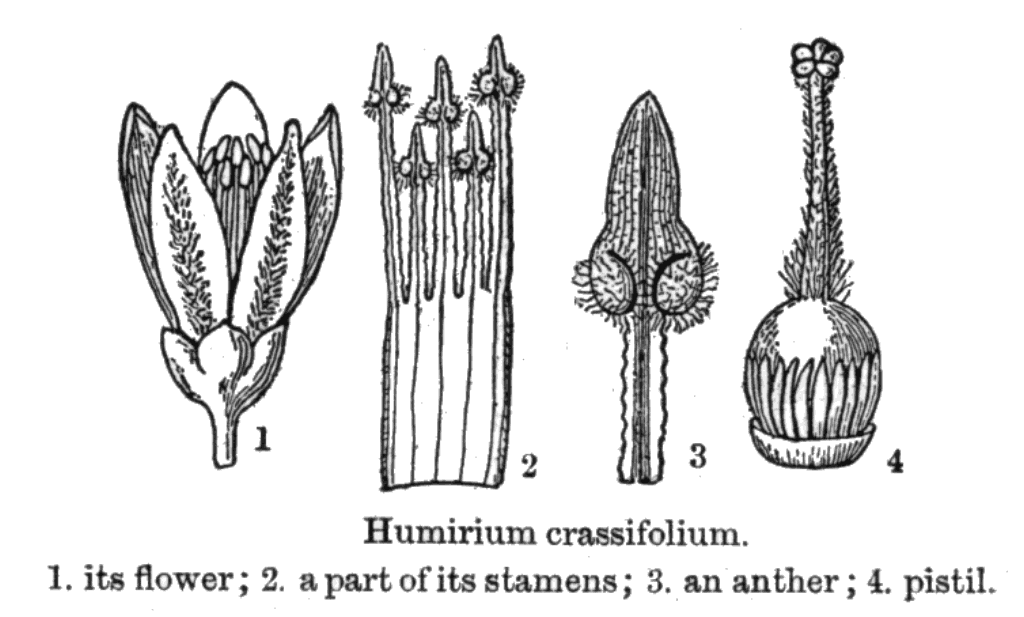
Alternatively Houmiriaceae Juss.
Habit and leaf form. Trees, or shrubs. Leaves evergreen; alternate; spiral, or distichous; leathery; petiolate; non-sheathing; aromatic (often, with `balsamic' juice), or without marked odour; simple. Lamina entire; pinnately veined; cross-venulate. Leaves stipulate, or exstipulate. Stipules when present, caducous (tiny). Lamina margins entire, or crenate, or serrate.
Leaf anatomy. Stomata present; anomocytic, or paracytic.
Lamina dorsiventral; without secretory cavities. The mesophyll with sclerencymatous idioblasts, or without sclerenchymatous idioblasts; containing calcium oxalate crystals. The mesophyll crystals druses, or solitary-prismatic.
Stem anatomy. Secretory cavities absent. Cork cambium present; initially superficial. Internal phloem absent. Secondary thickening developing from a conventional cambial ring. `Included' phloem absent. Xylem with tracheids. Vessel end-walls oblique; scalariform. Wood parenchyma apotracheal and paratracheal.
Reproductive type, pollination. Hermaphrodite.
Inflorescence, floral, fruit and seed morphology. Flowers aggregated in `inflorescences'; in panicles. The terminal inflorescence unit cymose. Inflorescences terminal (rarely), or axillary; axillary or rarely terminal thyrses. Flowers regular to somewhat irregular. Free hypanthium absent. Hypogynous disk present; intrastaminal; of separate members, or annular (cupular).
Perianth with distinct calyx and corolla; 10; 2 whorled; isomerous. Calyx 5 (but the lobes of the two outer members sometimes suppressed); 1 whorled; gamosepalous (usually connate below into a thickened tube or cup); three or five lobed; cupuliform, or tubular; persistent; imbricate. Corolla 5; 1 whorled; polypetalous (the petals usually 3-5 nerved, thick); imbricate, or contorted; persistent, or deciduous.
Androecium 10-30, or 40-100 (Vantanea). Androecial members branched (fascicled, with trunk bundles, or with clusters and singles); free of the perianth; coherent (the filaments connate for much of their length into a tube); 1-4 - whorled, or 5 - whorled (one to several series). Androecium exclusively of fertile stamens, or including staminodes. Stamens 10-100 (to `many'); diplostemonous to polystemonous; sometimes in 5 antesepalous clusters of three, and 5 antepetalous singles. Anthers dorsifixed to basifixed, or adnate (to the base of the fleshy connective); versatile; dehiscing via longitudinal slits; bilocular (the locules often well separated), or four locular; bisporangiate, or tetrasporangiate; conspicuously appendaged. The anther appendages apical (the connective expanded and prolonged). Pollen shed as single grains. Pollen grains aperturate; 3(-4) - aperturate; porate (rarely), or colporate.
Gynoecium (4-)5(-7). Carpels reduced in number relative to the perianth to isomerous with the perianth to increased in number relative to the perianth. Gynoecium syncarpous; synstylovarious to eu-syncarpous; superior. Ovary (4-)5(-7) locular; sessile. Gynoecium stylate. Styles 1; apical. Stigmas 1; (4-)5(-7) - lobed (or entire). Placentation axile to apical. Ovules 1-2 per locule; pendulous; epitropous (the micropyle directed upwards and outwards); with ventral raphe; when paired, superposed; anatropous; bitegmic; crassinucellate. Endothelium differentiated. Endosperm formation probably nuclear.
Fruit fleshy (with more or less fleshy exocarp); indehiscent; a drupe (the endocarp woody, sometimes with resin cavities, then buoyant for distribution by water); usually 1 seeded, or 2 seeded (germinating by valves or opercula). Seeds copiously endospermic. Endosperm oily. Cotyledons 2 (?). Embryo slightly curved, or straight.
Physiology, biochemistry. Ellagic acid present.
Geography, cytology. Paleotropical and Neotropical. Tropical. Tropical America, and one species in tropical West Africa. X = 12.
Taxonomy. Subclass Dicotyledonae; Crassinucelli. Dahlgren's Superorder Rutiflorae; Geraniales. Cronquist's Subclass Rosidae; Linales. Takhtajan's Subclass Rosidae; Rutanae; Geraniales. Species 50. Genera 8; Duckesia, Endopleura, Hylocarpa, Humiria (Houmiria), Humiriastrum, Sacoglottis, Schistostemon, Vantanea.
Cuatrecasas 1961.
Illustrations. humir447.gif