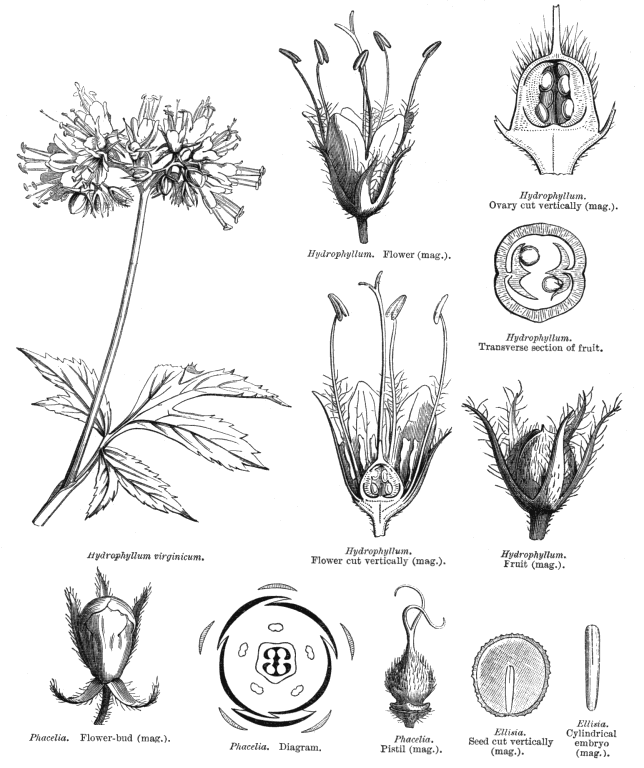
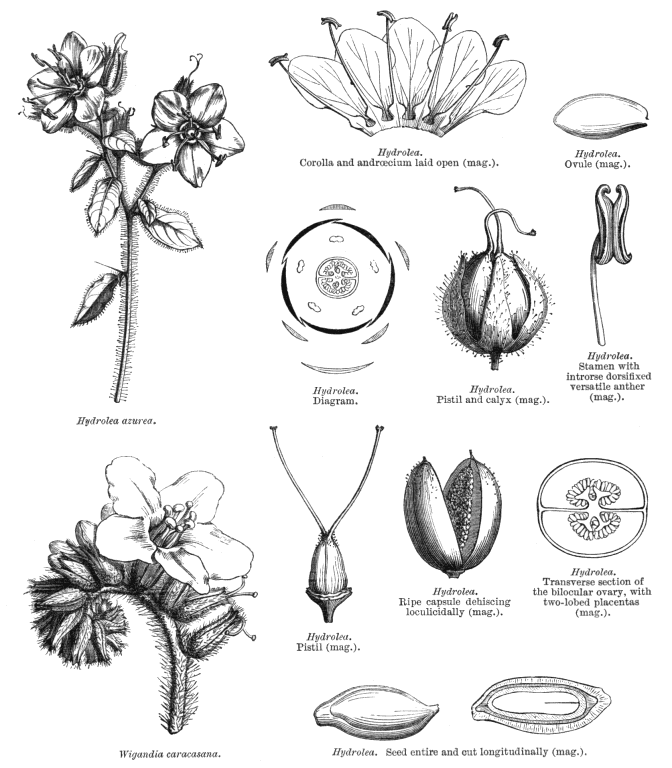
Including Hydrole(ace)ae R.Br.
Habit and leaf form. Herbs (usually), or shrubs (sometimes spiny). Annual, biennial, and perennial; with a basal aggregation of leaves, or with neither basal nor terminal aggregations of leaves. Mesophytic. Leaves alternate, or opposite; spiral; petiolate; non-sheathing; without marked odour, or foetid; simple, or compound; when compound, pinnate, or palmate (rarely). Lamina dissected, or entire; when simple/dissected, pinnatifid; pinnately veined, or palmately veined (rarely); cross-venulate. Leaves exstipulate; without a persistent basal meristem.
Leaf anatomy. Stomata present; mainly confined to one surface, or on both surfaces; anomocytic.
Lamina dorsiventral, or isobilateral. Minor leaf veins with phloem transfer cells (5 genera), or without phloem transfer cells (Wigandia).
Stem anatomy. Cork cambium present; initially superficial. Nodes unilacunar. Secondary thickening developing from a conventional cambial ring. Xylem with tracheids, or without tracheids. Vessel end-walls simple. Wood parenchyma apotracheal (diffuse).
Reproductive type, pollination. Hermaphrodite. Entomophilous; via hymenoptera.
Inflorescence, floral, fruit and seed morphology. Flowers aggregated in `inflorescences' (usually), or solitary (rarely); in cymes. The terminal inflorescence unit cymose. Inflorescences `boragoid' cincinni. Flowers often ebracteolate; regular; usually 5 merous; cyclic; tetracyclic. Free hypanthium absent. Hypogynous disk absent (usually), or present.
Perianth with distinct calyx and corolla; (8-)10(-20); 2 whorled; isomerous. Calyx (4-)5(-10); 1 whorled; gamosepalous, or polysepalous (sometimes `lobes divided to the base'); regular; imbricate. Epicalyx present (as appendages between the calyx lobes), or absent. Corolla (4-)5(-10); 1 whorled; appendiculate (often having scales inside the tube, alternating with the stamens), or not appendiculate; gamopetalous; imbricate, or contorted; rotate, or campanulate, or funnel-shaped; regular; blue, or purple, or white.
Androecium (4-)5(-10) (as many as C). Androecial members adnate (to the corolla tube, and usually with basal appendages also united to the corolla, which in Hydrophyllum form tubes leading to the nectar); all equal, or markedly unequal; free of one another; 1 - whorled. Androecium exclusively of fertile stamens. Stamens (4-)5(-10); isomerous with the perianth; oppositisepalous (alternating with the petals). Filaments variously, basally appendiculate. Anthers dorsifixed; versatile; dehiscing via longitudinal slits; introrse; appendaged. Microsporogenesis simultaneous. Tapetum glandular. Pollen grains aperturate; 3 - aperturate, or 5-6 - aperturate; colpate, or colporate, or rugate; 2-celled.
Gynoecium 2; syncarpous; synovarious to synstylovarious; superior (usually), or partly inferior (sometimes). Ovary 1 locular, or 2 locular. Gynoecium median; stylate. Styles 1, or 2; free, or partially joined; attenuate from the ovary; apical. Stigmas dry type; papillate; Group II type. Placentation when unilocular, parietal; when bilocular, axile. Ovules in the single cavity when unilocular, 2-100 (i.e. to `many'); when bilocular 2-50 per locule (i.e. to `many'); funicled, or sessile; pendulous (when funicled); non-arillate; anatropous, or amphitropous; unitegmic; tenuinucellate. Endothelium differentiated. Embryo-sac development Polygonum-type. Polar nuclei fusing prior to fertilization. Antipodal cells formed, or not formed (then the three nuclei degenerating early - Hydrolea); when formed, 3; not proliferating; ephemeral. Synergids sometimes with filiform apparatus. Endosperm formation cellular, or nuclear, or cellular to nuclear. Embryogeny solanad.
Fruit non-fleshy; dehiscent (usually), or indehiscent; a capsule, or capsular-indehiscent. Capsules when dehiscent, loculicidal (usually), or splitting irregularly, or septicidal (rarely). Seeds copiously endospermic. Endosperm oily. Cotyledons 2. Embryo chlorophyllous (1/1), or achlorophyllous (1/2); straight (spathulate or linear).
Seedling. Germination phanerocotylar.
Physiology, biochemistry. Not cyanogenic. Alkaloids absent (6 species). Iridoids absent. Proanthocyanidins absent. Flavonols present; kaempferol and quercetin. Ellagic acid absent (2 genera). Saponins/sapogenins present (rarely), or absent. Aluminium accumulation not found. C3. C3 recorded in Ellisia.
Geography, cytology. Temperate to tropical. Widespread. X = 5-13(+).
Taxonomy. Subclass Dicotyledonae; Tenuinucelli. Dahlgren's Superorder Solaniflorae; Boraginales. Cronquist's Subclass Asteridae; Solanales. Takhtajan's Subclass Asteridae; Lamianae; Polemoniales. Species 250. Genera 17; Codon, Draperia, Ellisia, Emmenanthe, Eriodictyon, Eucrypta, Hesperochiron, Hydrolea, Hydrophyllum, Nama, Nemophila, Phacelia, Pholistoma, Romanzoffia, Tricardia, Turricula, Wigandia.
Illustrations. hydro560.gif hydro562.gif