Including Embeli(ac)eae J.G. Agardh, Ophiospermae(`-spermes') Vent., Ophiospermataceae Kuntze
Excluding Aegicerataceae
Habit and leaf form. Trees and shrubs, or lianas (a few - and a few sub-herbaceous); with coloured juice, or non-laticiferous and without coloured juice; resinous. Climbing (a few), or self supporting (mostly). Mesophytic. Leaves alternate; spiral; petiolate; non-sheathing; gland-dotted (often), or not gland-dotted (then glandular-hairy); aromatic, or without marked odour; simple. Lamina entire; pinnately veined; cross-venulate. Leaves exstipulate. Lamina margins often entire. Leaves without a persistent basal meristem. Domatia recorded (3 genera); represented by pockets, or hair tufts.
Leaf anatomy. Mucilaginous epidermis present, or absent.
Lamina with secretory cavities (usually), or without secretory cavities. Secretory cavities containing resin (yellow or reddish brown); Secretory cavities schizogenous. The mesophyll often with hypodermal fibres. Minor leaf veins without phloem transfer cells (Ardisia, Suttonia (= Rapanea)).
Stem anatomy. Secretory cavities commonly present; with resin (yellow or reddish-brown). Cork cambium present; initially superficial. Nodes unilacunar. Secondary thickening developing from a conventional cambial ring. Xylem with fibre tracheids, or without fibre tracheids; with libriform fibres; with vessels. Vessel end-walls simple, or scalariform and simple. Vessels without vestured pits. Wood parenchyma paratracheal.
Reproductive type, pollination. Hermaphrodite, or monoecious, or polygamomonoecious, or dioecious. The female flowers often with large staminodes.
Inflorescence, floral, fruit and seed morphology. Flowers aggregated in `inflorescences'. The terminal inflorescence unit racemose. Inflorescences axillary, or terminal. Flowers bracteolate (usually bibracteolate), or ebracteolate; small; regular; mostly 4-5 merous; cyclic; tetracyclic. Free hypanthium absent.
Perianth with distinct calyx and corolla; 6-12; 2 whorled; isomerous. Calyx (3-)4-5(-6); 1 whorled; polysepalous, or gamosepalous (often basally connate); regular; imbricate, or contorted, or valvate. Corolla (3-)4-5(-6); 1 whorled; gamopetalous (usually), or polypetalous (e.g. Embelia); imbricate, or contorted, or valvate; regular; not fleshy.
Androecium (3-)4-5(-6). Androecial members free of the perianth (rarely), or adnate (to the corolla tube); free of one another, or coherent (sometimes); when coherent, 1 - adelphous (the filaments connate); 1 - whorled. Androecium of male-fertile flowers exclusively of fertile stamens, or including staminodes (occasionally). Stamens (3-)4-5(-6); usually isomerous with the perianth; alternisepalous. Anthers cohering (Amblyanthus), or separate from one another; dehiscing via longitudinal slits, or dehiscing via pores; introrse; tetrasporangiate. Endothecium not developing fibrous thickenings (in Badula). Pollen grains aperturate; 3(-5) - aperturate; colpate, or colporate (col(por)oidate, sometimes 4-rupate); 2-celled.
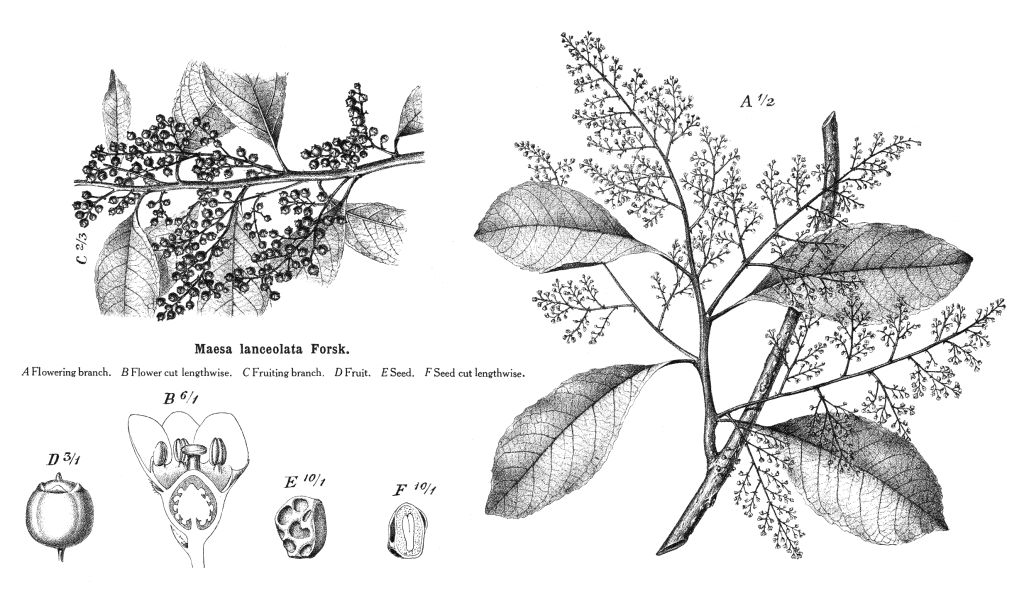
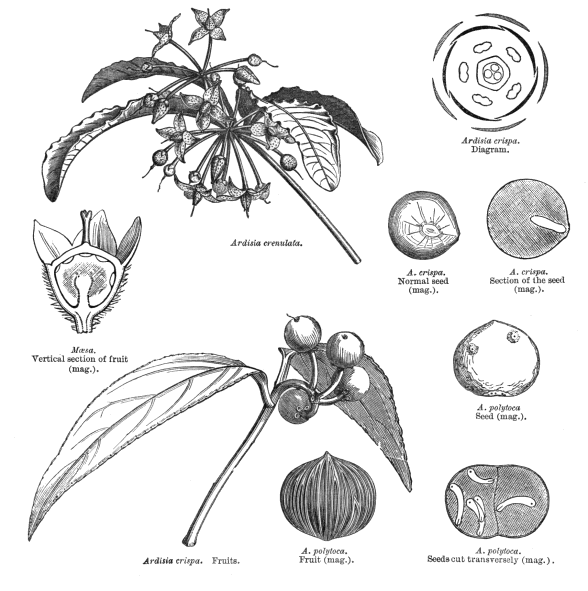
Gynoecium 3-5(-6). Carpels isomerous with the perianth, or reduced in number relative to the perianth, or increased in number relative to the perianth. Gynoecium syncarpous; eu-syncarpous; superior (nearly always), or partly inferior (Maesa). Ovary 1 locular. Gynoecium stylate. Styles 1; attenuate from the ovary; apical. Stigmas 1; dry type; papillate; Group II type. Placentation basal, or free central. Ovules in the single cavity 3-100 (`few to many'); sunken in the placenta; ascending; non-arillate; anatropous; bitegmic; tenuinucellate. Outer integument not contributing to the micropyle. Endothelium differentiated. Embryo-sac development Polygonum-type. Endosperm formation nuclear. Embryogeny onagrad (?).
Fruit fleshy; indehiscent; a berry, or a drupe; 1 seeded (usually), or 3-100 seeded (`many' only in Maesa). Seeds endospermic. Endosperm oily. Seeds with amyloid. Cotyledons 2. Embryo achlorophyllous (1/3); straight to curved. Polyembryony recorded (e.g. Ardisia).
Seedling. Germination phanerocotylar, or cryptocotylar.
Physiology, biochemistry. Not cyanogenic. Alkaloids present (rarely), or absent. Iridoids absent. Proanthocyanidins present (usually), or absent; cyanidin, or delphinidin, or cyanidin and delphinidin. Flavonols present; kaempferol, or kaempferol and quercetin, or myricetin. Ellagic acid absent (5 genera, 5 species). Saponins/sapogenins present, or absent. Anatomy non-C4 type (Ardisia).
Geography, cytology. Temperate to tropical. Pantropical, subtropical and extending North to Japan and Florida, and South to New Zealand. X = 10-13, 23.
Taxonomy. Subclass Dicotyledonae; Crassinucelli. Dahlgren's Superorder Primuliflorae; Primulales. Cronquist's Subclass Dilleniidae; Primulales. Takhtajan's Subclass Dilleniidae; Ericanae; Primulales. Species 1000. Genera about 35; Amblyanthopsis, Amblyanthus, Antistrophe, Ardisia, Badula, Conandrium, Ctenardisia, Cybianthus, Discocalyx, Elingamita, Embelia, Emblemantha, Fittingia, Geissanthus, Heberdenia, Hymenandra, Labisia, Loheria, Maesa, Monoporus, Myrsine, Oncostemum, Parathesis, Pleiomeris, Rapanea, Sadiria, Solonia, Stylogyne, Tapeinosperma, Tetrardisia, Vegaea, Wallenia.
Illustrations. myrsi418.gif myrsi532.gif