Including Pistiaceae C.A. Agardh (p.p.)
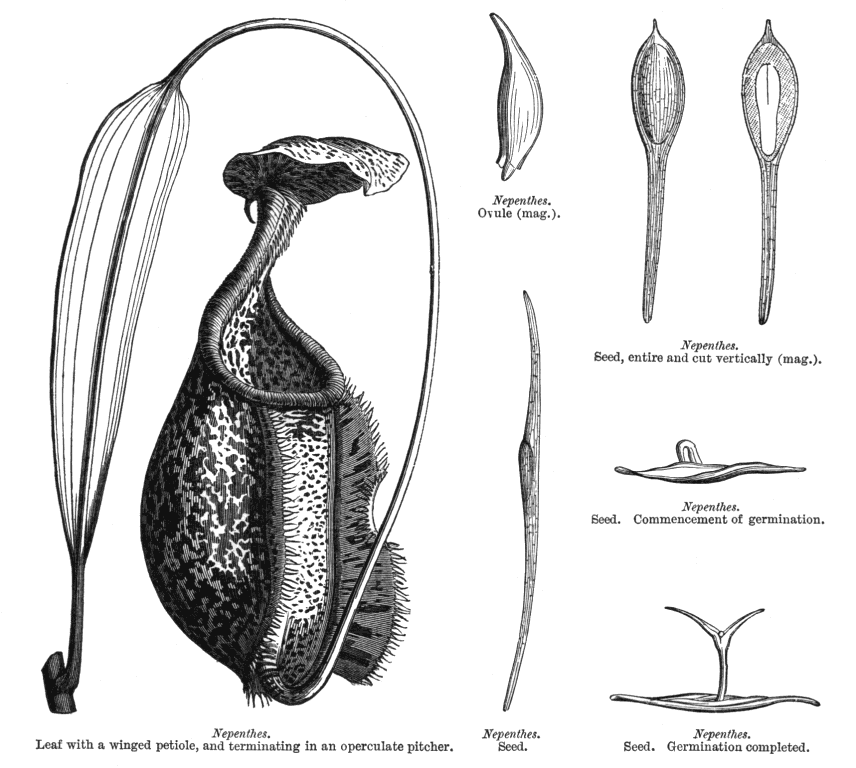
Habit and leaf form. Shrubs, or lianas, or herbs (mostly of boggy places, usually more or less woody). `Carnivorous'. Trapping mechanism passive. The traps consisting of `pitchers'. Perennial; with neither basal nor terminal aggregations of leaves. Epiphytic, or climbing, or epiphytic and climbing, or self supporting; mostly tendril climbers (the lamina midrib prolonged into a twining tendril, the tendril terminated by a pitcher). Mostly helophytic. Heterophyllous (sometimes with pitcher-bearing and non-pitcher-bearing leaves), or not heterophyllous. Leaves alternate; spiral; petiolate (the petiole winged); sheathing. Leaf sheaths tubular; with free margins. Leaves simple (at least, not `compound' in the normal sense). Lamina entire; more or less linear (or strap-shaped); basically parallel-veined; cross-venulate. Leaves exstipulate. Lamina margins entire.
Leaf anatomy. Adaxial hypodermis present (aqueous). Minor leaf veins without phloem transfer cells (Nepenthes).
Stem anatomy. Cork cambium present; initially deep-seated. Primary vascular tissue comprising a ring of bundles. Cortical bundles present, or absent. Medullary bundles present, or absent. Secondary thickening developing from a conventional cambial ring. `Included' phloem absent. Xylem with tracheids; with vessels. Vessel end-walls horizontal; simple.
Reproductive type, pollination. Dioecious. Entomophilous.
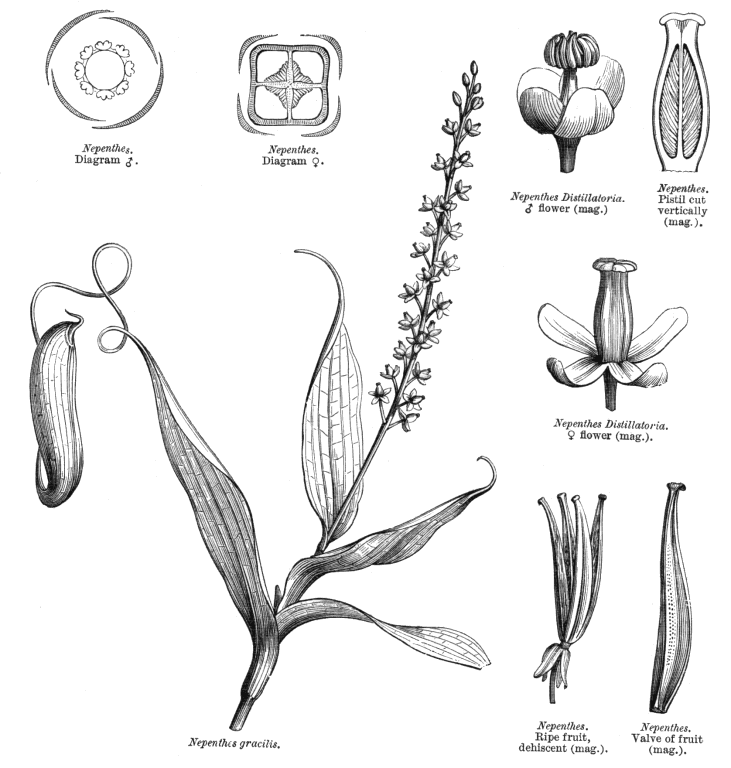
Inflorescence, floral, fruit and seed morphology. Flowers aggregated in `inflorescences'; in cymes and in racemes. The terminal inflorescence unit cymose, or racemose. Inflorescences racemes and thyrses. Flowers ebracteate; ebracteolate; small; fragrant; regular; cyclic.
Perianth sepaline; (3-)4; free; 2 whorled (2+2, according to Airy Shaw); usually isomerous. Calyx (if the perianth regarded as such) (3-)4; 2 whorled; usually polysepalous, or gamosepalous (sometimes?). Degree of gamosepaly, maximum length joined/total calyx length 2. Calyx regular; imbricate.
Androecium (4-)8-25. Androecial members free of the perianth; coherent; 1 - adelphous (the filaments united into a column). Androecium exclusively of fertile stamens. Stamens (4-)8-25; isomerous with the perianth to polystemonous. Anthers dehiscing via longitudinal slits; extrorse; tetrasporangiate. Pollen shed in aggregates; in tetrads. Pollen grains indistinctly aperturate to nonaperturate; 2-celled.
Gynoecium (3-)4; syncarpous; eu-syncarpous; superior. Ovary (3-)4 locular. Styles 1 (very short -the stigma almost sessile); very much shorter than the mature ovary. Stigmas 1; capitate to subpeltate; dry type; papillate; Group II type. Placentation axile (with many rows). Ovules 9-50 per locule (`many'); ascending; non-arillate; anatropous; bitegmic; crassinucellate. Outer integument contributing to the micropyle. Embryo-sac development Polygonum-type. Polar nuclei fusing prior to fertilization. Antipodal cells formed; 3; not proliferating. Synergids pear-shaped.
Fruit non-fleshy (leathery); dehiscent; a capsule. Capsules loculicidal. Fruit 20-100 seeded (`many'). Seeds endospermic. Endosperm oily (and starchy). Seeds filiform; winged (usually, with a narrow or hairlike wing at either end), or wingless (Aneurosperma). Seeds with starch. Embryo well differentiated (very short). Cotyledons 2. Embryo straight.
Seedling. Germination phanerocotylar.
Physiology, biochemistry. Not cyanogenic. Iridoids absent. Proanthocyanidins present; cyanidin. Flavonols present; kaempferol and quercetin. Ellagic acid absent (2 species of Nepenthes). Aluminium accumulation not found.
Geography, cytology. Tropical. Seychelles, Indomalayan region, Madagascar, Ceylon, tropical Australia, New Caledonia.
Taxonomy. Subclass Dicotyledonae; Crassinucelli. Dahlgren's Superorder Theiflorae; Theales. Cronquist's Subclass Dilleniidae; Nepenthales. Takhtajan's Subclass Rosidae; Rosanae; Nepenthales. Species 68. Genera 2; Nepenthes, Anurosperma.
Illustrations. nepen703.gif nepen704.gif