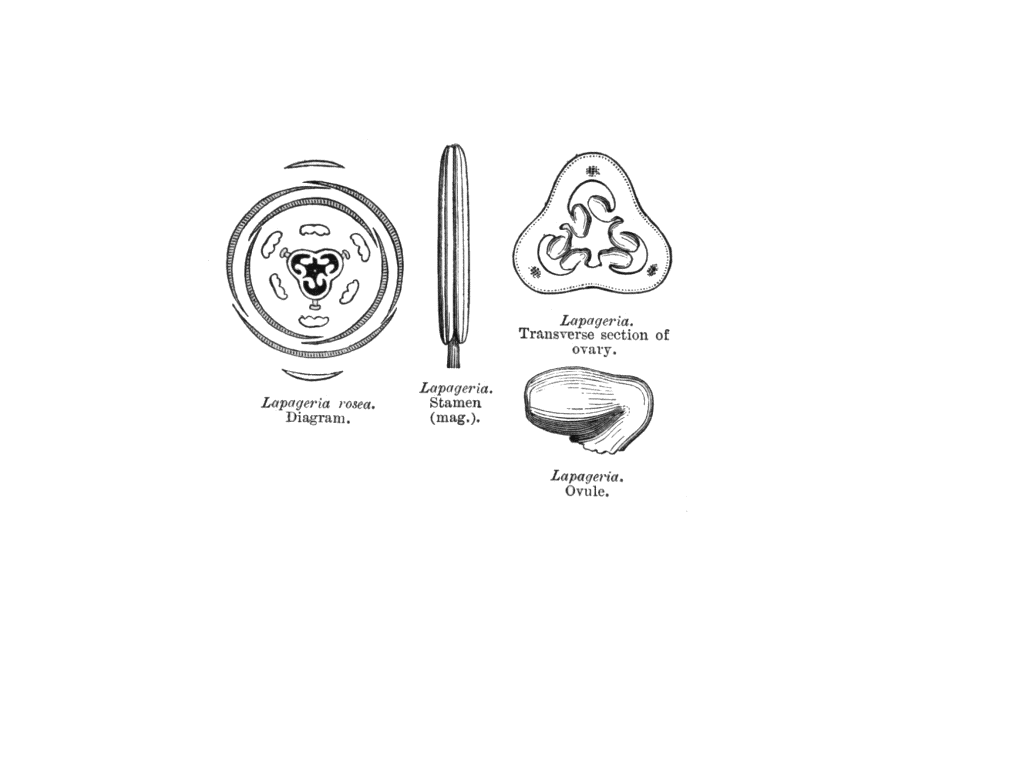
Excluding Luzuriagaceae, Petermanniaceae
Habit and leaf form. Shrubs (undershrubs), or lianas. Self supporting, or climbing; when climbing, stem twiners. Mesophytic, or xerophytic. Leaves alternate; leathery (or sclerophyllous); petiolate, or subsessile, or sessile; sheathing, or non-sheathing. Leaf sheaths with free margins. Leaves simple. Lamina entire; linear, or lanceolate, or ovate; palmately veined (palmate-parallel); cross-venulate. Lamina margins entire.
Leaf anatomy. Stomata present; anomocytic.
Minor leaf veins without phloem transfer cells (Lapageria, Philesia). Vessels absent.
Stem anatomy. Xylem with vessels, or without vessels. Vessel end-walls scalariform.
Root anatomy. Root xylem with vessels, or without vessels (then with `vessel tracheids'). Vessel end-walls scalariform.
Reproductive type, pollination. Hermaphrodite. Floral nectaries present. Nectar secretion from the perianth (from pouches at the bases of the tepals).
Inflorescence, floral, fruit and seed morphology. Flowers solitary; bracteolate (with several bracteoles); medium-sized; regular; 3 merous; cyclic; pentacyclic. Perigone tube absent (but the tepals together forming a campanulate structure).
Perianth with distinct calyx and corolla, or of `tepals'; 6; free; 2 whorled; isomerous; sepaloid and petaloid, or petaloid (if not resolvable into calyx and corolla); spotted; different in the two whorls.
Androecium 6. Androecial members free of the perianth; free of one another, or coherent; when filaments joined 1 - adelphous; 2 - whorled. Androecium exclusively of fertile stamens. Stamens 6; diplostemonous. Anthers sub basifixed; dehiscing via longitudinal slits; extrorse, or introrse; tetrasporangiate. Endothecium developing fibrous thickenings. The thickenings spiral. Anther epidermis persistent. Microsporogenesis successive. Tapetum probably glandular. Pollen shed as single grains. Pollen grains nonaperturate; 2-celled.
Gynoecium 3. Carpels isomerous with the perianth. Gynoecium syncarpous; eu-syncarpous; superior. Ovary 1 locular. Gynoecium stylate. Styles 1. Stigmas wet type; papillate; Group III type. Placentation parietal (intrusive). Ovules in the single cavity 10-100 (`several to many'); anatropous; bitegmic; crassinucellate. Outer integument not contributing to the micropyle. Embryo-sac development Polygonum-type. Polar nuclei fusing prior to fertilization. Antipodal cells formed; 3 (large); not proliferating. Synergids pear-shaped.
Fruit indehiscent; a berry. Seeds copiously endospermic. Endosperm oily. Embryo well differentiated. Embryo straight. Testa without phytomelan.
Seedling. Nitrogen-fixing root nodules absent. Physiology, biochemistry. Saponins/sapogenins present (steroidal).
Geography, cytology. Neotropical and Antarctic. Temperate to tropical. Chile. X = 15, 19.
Taxonomy. Subclass Monocotyledonae. Superorder Liliiflorae; Asparagales. Species 2. Genera 2; Philesia, Lapageria.
Illustrations. phile217.gif phile856.gif
Additional, to be intercalated. Lapageria twining clockwise. Flowers terminal (on short branchlets), or axillary.