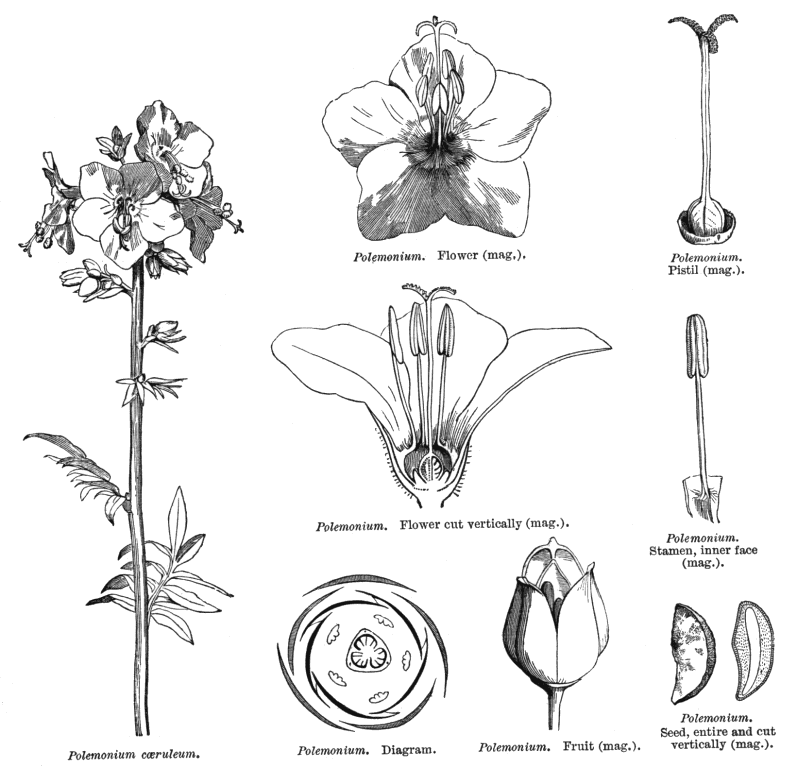
Excluding Cobaeaceae
Habit and leaf form. Herbs, or shrubs (sometimes), or trees (Cantua); non-laticiferous and without coloured juice. Annual to perennial; with neither basal nor terminal aggregations of leaves. Leaves alternate, or opposite, or whorled (Gymnosteris); when alternate, spiral; petiolate to sessile; simple, or compound; when compound pinnate, or palmate. Lamina when simple, dissected, or entire; pinnatifid, or palmately lobed; cross-venulate. Leaves exstipulate. Lamina margins entire, or serrate, or dentate.
Leaf anatomy. Mucilaginous epidermis present, or absent. Stomata present; mainly confined to one surface (abaxial), or on both surfaces (usually); anomocytic, or paracytic.
Lamina dorsiventral, or isobilateral. Minor leaf veins without phloem transfer cells (Phlox, Polemonium).
Stem anatomy. Cork cambium present; initially deep-seated, or superficial. Nodes unilacunar. Primary vascular tissue centrifugal. Internal phloem absent. Secondary thickening developing from a conventional cambial ring. `Included' phloem absent. Xylem with tracheids, or without tracheids (?); with fibre tracheids, or without fibre tracheids; with vessels. Vessel end-walls simple, or scalariform and simple (with few cross bars). Wood partially storied (VPI), or not storied (?).
Reproductive type, pollination. Hermaphrodite.
Inflorescence, floral, fruit and seed morphology. Flowers solitary (sometimes), or aggregated in `inflorescences'; in cymes, or in heads, or in corymbs. The terminal inflorescence unit cymose. Inflorescences cymes or corymbs, sometimes condensed into heads; with involucral bracts, or without involucral bracts; pseudanthial, or not pseudanthial. Flowers bracteolate, or ebracteolate; regular (usually), or somewhat irregular; when irregular, slightly zygomorphic (then slightly bilabiate); 5 merous; cyclic; tetracyclic. Free hypanthium absent. Hypogynous disk present; intrastaminal; of separate members, or annular.
Perianth with distinct calyx and corolla; 10; 2 whorled; isomerous. Calyx 5; 1 whorled; gamosepalous; five lobed; bilabiate to regular; persistent; imbricate, or valvate. Corolla 5; 1 whorled; gamopetalous; usually contorted; campanulate, or funnel-shaped, or hypocrateriform; bilabiate to regular.
Androecium 5. Androecial members adnate (epipetalous); free of one another; 1 - whorled. Androecium exclusively of fertile stamens. Stamens 5; isomerous with the perianth; oppositisepalous. Anthers dehiscing via longitudinal slits; tetrasporangiate; unappendaged. Endothecium developing fibrous thickenings. Microsporogenesis simultaneous. The initial microspore tetrads tetrahedral. Anther wall initially with one middle layer; of the `dicot' type. Pollen grains aperturate; 7-32 - aperturate; porate, or colporate (colpoidorate?), or foraminate; 2-celled.
Gynoecium (2-)3(-5). Carpels reduced in number relative to the perianth, or isomerous with the perianth. Gynoecium syncarpous; synstylovarious; superior. Ovary (2-)3(-5) locular. Gynoecium median. Ovary sessile. Gynoecium stylate. Styles 1 (filiform). Stigmas (2-)3(-5); (2-)3(-5) - lobed. Placentation axile. Ovules 1-50 per locule (to `many'); sessile; anatropous; unitegmic; tenuinucellate. Endothelium differentiated. Embryo-sac development Polygonum-type. Polar nuclei fusing prior to fertilization. Antipodal cells formed; 3; not proliferating; ephemeral. Synergids pear-shaped. Endosperm formation nuclear. Embryogeny chenopodiad.
Fruit non-fleshy; dehiscent (usually), or indehiscent; a capsule (usually), or capsular-indehiscent. Capsules usually loculicidal. Seeds endospermic. Endosperm oily. Cotyledons 2. Embryo chlorophyllous (2/3), or achlorophyllous (3 species of Polemonium); curved (slightly), or straight.
Seedling. Germination phanerocotylar.
Physiology, biochemistry. Not cyanogenic. Alkaloids absent (6 species). Iridoids absent. Proanthocyanidins absent. Flavonols present; kaempferol, or kaempferol and quercetin. Ellagic acid absent (2 genera, 2 species). Saponins/sapogenins present. Aluminium accumulation not found. C3. C3 recorded in Cantua, Gilia, Phlox, Polemonium.
Geography, cytology. Holarctic and Neotropical. Frigid zone to sub-tropical. Widespread, but lacking (though often introduced) in Africa, Southern and Southeast Asia Malaysia, Australia and Eastern South America. X = 6, 7, 8, 9. Supposed basic chromosome number of family 9.
Taxonomy. Subclass Dicotyledonae; Tenuinucelli. Dahlgren's Superorder Solaniflorae; Solanales. Cronquist's Subclass Asteridae; Solanales. Takhtajan's Subclass Asteridae; Lamianae; Polemoniales. Species 300. Genera 18; Acanthogilia, Allophyllum, Bonplandia, Cantua, Collomia, Eriastrum, Gilia, Gymnosteris, Huthia, Ipomopsis, Langloisia, Leptodactylon, Linanthus, Loeselia, Loeseliastrum, Navarretia, Phlox, Polemonium.
Illustrations. polem564.gif