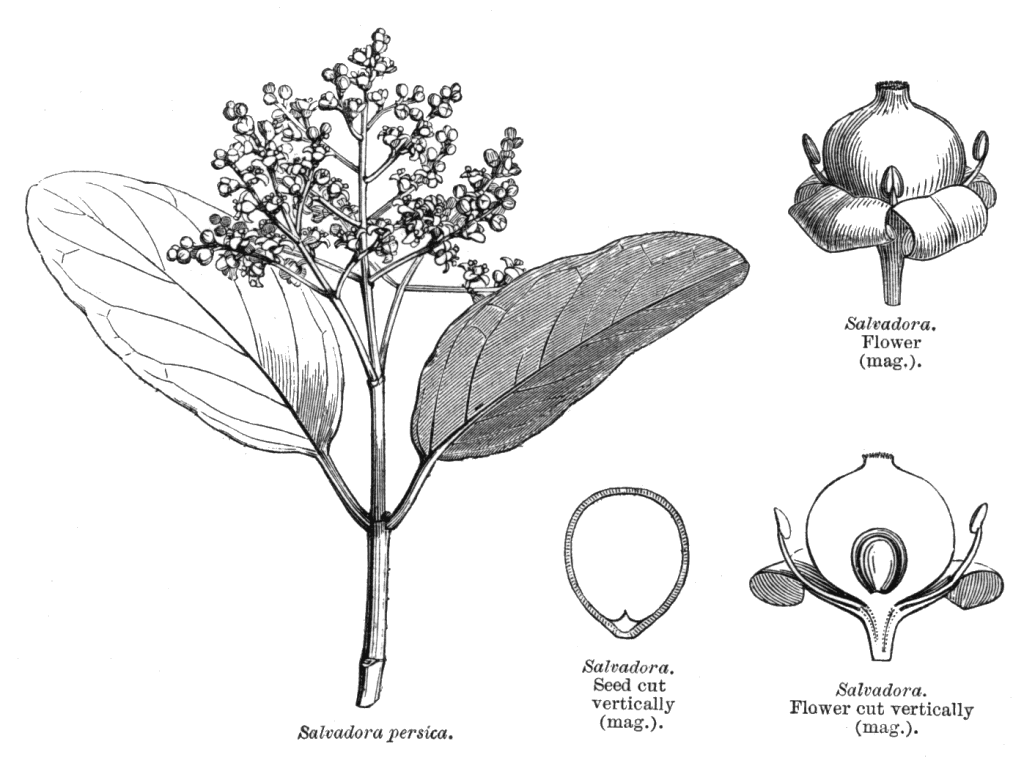
Habit and leaf form. Trees, or shrubs (sometimes spinose, with axillary spines). Self supporting, or climbing; when scandent, scrambling. Xerophytic (of hot, dry, often coastal or saline regions). Leaves opposite; `herbaceous', or leathery (usually olive grey); without marked odour; simple. Lamina entire. Leaves stipulate (often, but the stipules rudimentary), or exstipulate (?). Lamina margins entire.
Leaf anatomy. Stomata present; anomocytic, or anisocytic, or paracytic.
Adaxial hypodermis present, or absent. Lamina dorsiventral, or isobilateral. The mesophyll containing calcium oxalate crystals (but not oxalate). The mesophyll crystals druses. Minor leaf veins without phloem transfer cells (Salvadora).
Stem anatomy. Cork cambium present; initially superficial. Primary vascular tissue comprising a ring of bundles. Internal phloem absent. Secondary thickening anomalous; from a single cambial ring. `Included' phloem present. Xylem without fibre tracheids; with libriform fibres. Vessel end-walls simple. Wood storied, or partially storied (VPI); parenchyma paratracheal.
Reproductive type, pollination. Hermaphrodite, or dioecious, or polygamomonoecious, or polygamodioecious.
Inflorescence, floral, fruit and seed morphology. Flowers aggregated in `inflorescences'; in fascicles, or in panicles. The terminal inflorescence unit mostly racemose. Inflorescences terminal, or axillary; of various sorts, axillary or terminal, mostly indeterminate. Flowers small; regular; mostly 4 merous; cyclic; tetracyclic. Free hypanthium absent. Hypogynous disk present, or absent; intrastaminal; when present, of separate members (represented by small glands alternating with the stamens).
Perianth with distinct calyx and corolla; (6-)8(-10); 2 whorled; isomerous to anisomerous. Calyx 2-4(-5); 1 whorled; gamosepalous; lobed; regular; imbricate, or valvate. Corolla 4(-5); 1 whorled; appendiculate (with teeth or small glands on the inside - these representing staminodes?), or not appendiculate; polypetalous, or gamopetalous (shortly connate at the base in Salvadora); imbricate, or contorted; regular.
Androecium 4(-5), or 8(-10). Androecial members adnate, or free of the perianth and adnate; free of one another, or coherent (the stamens connate below into a tube, in Dobera); 1 - whorled, or 2 - whorled. Androecium exclusively of fertile stamens, or including staminodes (often, if teeth or glands inside the corolla are taken to be staminodal). Staminodes if present, 4(-5). Stamens 4(-5); isomerous with the perianth; oppositisepalous. Anthers dehiscing via longitudinal slits; bilocular (the loculi back to back); tetrasporangiate. Pollen shed as single grains. Pollen grains aperturate; 3 - aperturate (usually), or 6 - aperturate; colporate (usually tricolporate), or rugate (exceptionally 6-rug(or)oidate).
Gynoecium 2. Carpels reduced in number relative to the perianth. Gynoecium syncarpous; synstylovarious, or eu-syncarpous; superior. Ovary 1 locular (Dobera, Salvadora), or 2 locular (Azima). Gynoecium shortly stylate. Styles 1; apical; shorter than the mature ovary. Stigmas 1, or 2; entire or two-lobed. Placentation when unilocular, basal; when bilocular, basal to axile. Ovules in the single cavity 1-2; 1-2 per locule; ascending; apotropous; anatropous; bitegmic; crassinucellate. Outer integument not contributing to the micropyle. Embryo-sac development Polygonum-type. Polar nuclei fusing prior to fertilization. Antipodal cells formed; 3 (large); not proliferating. Synergids pear-shaped. Endosperm formation nuclear.
Fruit fleshy; indehiscent; a berry, or a drupe; mostly 1 seeded. Seeds non-endospermic. Embryo well differentiated. Cotyledons 2 (cordate, thickened, oily).
Physiology, biochemistry. Mustard-oils present. Cyanogenic. Alkaloids present, or absent. Iridoids absent. Proanthocyanidins absent. Flavonols present; quercetin. Ellagic acid absent (Salvadora). Aluminium accumulation not found. C3. C3 recorded in Salvadora. Anatomy non-C4 type (Salvadora).
Geography, cytology. Paleotropical. Sub-tropical to tropical. Africa, Madagascaar, Southern Asia, Malaysia. X = 12.
Taxonomy. Subclass Dicotyledonae; Crassinucelli. Dahlgren's Superorder Violiflorae; Salvadorales (or Capparidales). Cronquist's Subclass Rosidae; Celastrales. Takhtajan's Subclass Rosidae; Celastranae; Celastrales. Species 12. Genera 3; Azima, Dobera, Salvadora.
Illustrations. salva548.gif