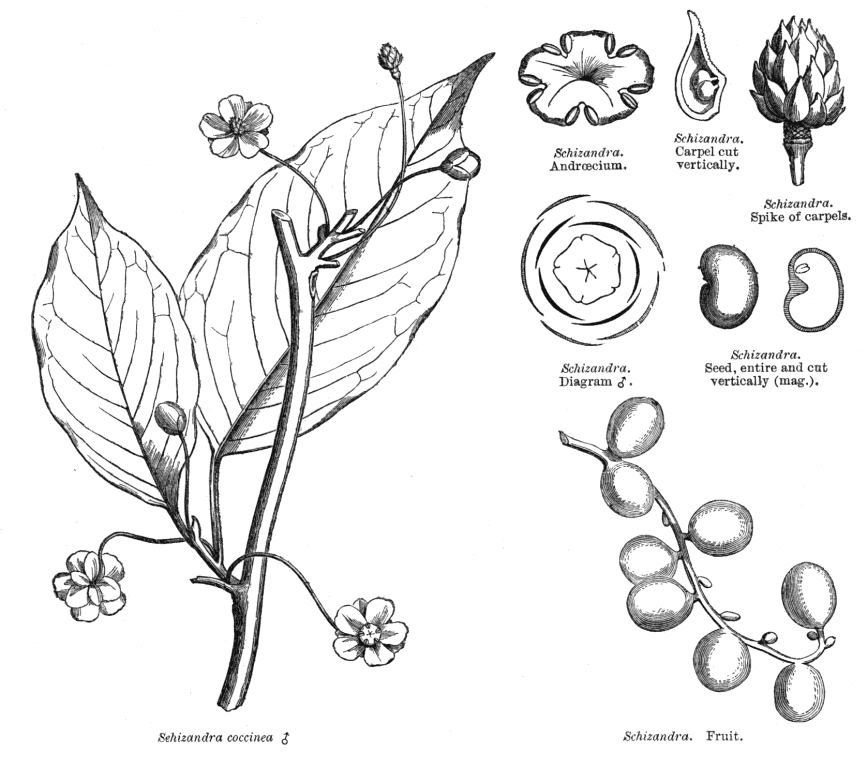
Habit and leaf form. Lianas; bearing essential oils. Climbing; stem twiners, or scrambling. Leaves evergreen, or deciduous; alternate; `herbaceous', or leathery; petiolate; non-sheathing; gland-dotted (often), or not gland-dotted; aromatic; simple. Lamina entire; pinnately veined; cross-venulate. Leaves exstipulate. Lamina margins entire, or dentate (more often).
Leaf anatomy. Mucilaginous epidermis present. Stomata present; mixed paracytic (and `laterocytic').
The mesophyll with spherical etherial oil cells; usually containing mucilage cells. Minor leaf veins without phloem transfer cells (Schisandra).
Stem anatomy. Cork cambium present; initially superficial. Nodes unilacunar (with three traces). Cortical bundles absent. Medullary bundles absent. Internal phloem absent. Secondary thickening developing from a conventional cambial ring. `Included' phloem absent. Xylem with tracheids; without fibre tracheids; without libriform fibres; with vessels. Vessel end-walls scalariform, or simple. Wood parenchyma apotracheal (terminal only). Sieve-tube plastids S-type.
Reproductive type, pollination. Monoecious, or dioecious.
Inflorescence, floral, fruit and seed morphology. Flowers solitary, or aggregated in `inflorescences' (these 2--few flowered). Inflorescences axillary. Flowers small; usually fragrant; regular; acyclic. The perianth acyclic, the androecium acyclic, and the gynoecium acyclic (spiralled throughout). Floral receptacle not markedly hollowed (conic to cylindrical or obovoid). Free hypanthium absent. Hypogynous disk absent.
Perianth sequentially intergrading from sepals to petals, or of `tepals'; (5-)9-15(-24); free; spiralled, in two to several series; similar in the two whorls, or different in the two whorls.
Androecium of male flowers, 4-80. Androecial members maturing centripetally (?!); free of one another to coherent (the filaments connate basally to to wholly connate in a globular, fleshy mass); spiralled. Androecium exclusively of fertile stamens. Stamens 4-80; filantherous (the filaments short). Anthers basifixed, or adnate; non-versatile; dehiscing via longitudinal slits; extrorse to introrse; tetrasporangiate. Endothecium developing fibrous thickenings. Anther epidermis persistent. Microsporogenesis simultaneous. The initial microspore tetrads tetrahedral, or decussate. Anther wall initially with one middle layer, or initially with more than one middle layer (1 to 3); of the `dicot' type. Tapetum glandular. Pollen shed as single grains. Pollen grains aperturate; 6 - aperturate (typically), or 3 - aperturate (rarely - usually with three short colpi alternating with three long ones, the latter meeting at one pole); colpate; 2-celled.
Gynoecium 12-300; apocarpous; eu-apocarpous (spirally arranged); superior. Carpel incompletely closed (unsealed); with a longitudinal stigmatic surface (the stigma decurrent); 2-5(-11) ovuled. Placentation marginal. Stigmas wet type; papillate; Group III type. Ovules pendulous; collateral, or superposed; anatropous to campylotropous; bitegmic; crassinucellate. Outer integument contributing to the micropyle. Embryo-sac development Polygonum-type. Polar nuclei fusing prior to fertilization. Antipodal cells formed; 3; not proliferating; very ephemeral. Synergids pear-shaped. Endosperm formation cellular. Embryogeny onagrad, or asterad.
Fruit fleshy; multiple (the fruiting carpels on a somewhat elongate axis, or in a dense head). The fruiting carpel indehiscent; baccate. Fruit typically 2 seeded. Seeds copiously endospermic. Endosperm oily (and starchy). Seeds flattened. Seeds with starch. Embryo well differentiated (but minute). Cotyledons 2. Embryo straight.
Physiology, biochemistry. Not cyanogenic. Iridoids absent. Proanthocyanidins present; cyanidin and delphinidin. Flavonols present; kaempferol, quercetin, and myricetin. Ellagic acid absent (Kadsura). Arbutin absent. Saponins/sapogenins absent.
Geography, cytology. Holarctic and Paleotropical. Temperate to tropical. Eastern and Southeastern Eurasia, Malaysia, Southeastern U.S.A. X = 13, 14.
Taxonomy. Subclass Dicotyledonae; Crassinucelli. Dahlgren's Superorder Magnoliiflorae; Illiciales. Cronquist's Subclass Magnoliidae; Illiciales. Takhtajan's Subclass Magnoliidae; Magnolianae; Illiciales. Species 47. Genera 2; Kadsura, Schisandra.
Illustrations. schis196.gif
Additional, to be intercalated. Schisandra twining clockwise.