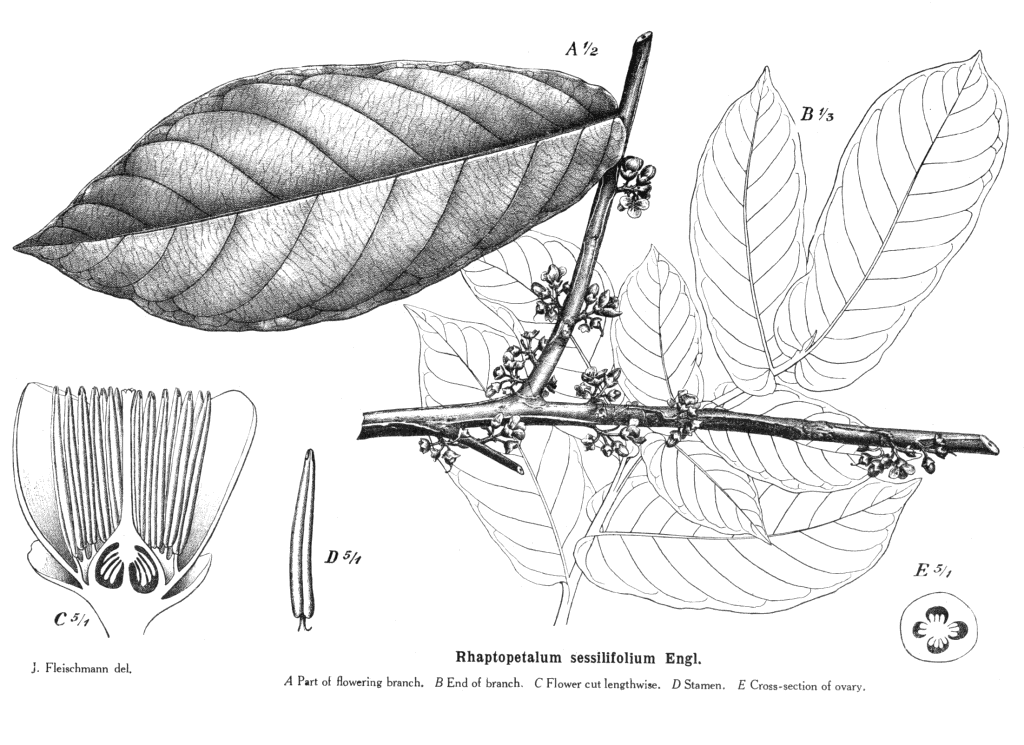
Including Rhaptopetalaceae Pierre ex Van Tiegh.
Habit and leaf form. Trees, shrubs, and herbs; non-laticiferous and without coloured juice. Leaves alternate; spiral, or distichous; leathery; shortly petiolate to sessile; simple. Lamina entire; pinnately veined; often asymmetric at the base. Leaves exstipulate. Lamina margins entire, or dentate.
Leaf anatomy. Stomata present; mainly confined to one surface, or on both surfaces; anisocytic. Hairs present, or absent; when present, eglandular; unicellular. Unicellular hairs unbranched.
Lamina dorsiventral (usually), or isobilateral (the palisade sometimes indistinct); without secretory cavities. The mesophyll without etherial oil cells; not containing mucilage cells; with sclerencymatous idioblasts (commonly), or without sclerenchymatous idioblasts.
Stem anatomy. Cork cambium present; initially superficial. The cortex containing cristarque cells, or without cristarque cells (Rhaptopetalum). Cortical bundles present (two, sometimes), or absent. Medullary bundles absent. Internal phloem absent. Secondary thickening developing from a conventional cambial ring. The secondary phloem stratified into hard (fibrous) and soft (parenchymatous) zones. Xylem with fibre tracheids, or without fibre tracheids; with libriform fibres, or without libriform fibres. Vessel end-walls simple, or scalariform and simple. Primary medullary rays narrow. Wood parenchyma apotracheal.
Reproductive type, pollination. Hermaphrodite.
Inflorescence, floral, fruit and seed morphology. Flowers aggregated in `inflorescences'; in racemes, or in panicles. Inflorescences terminal (panicles), or axillary (racemes); terminal panicles or axillary racemes, or in clusters on the old wood. Flowers regular. Free hypanthium absent. Hypogynous disk present; extrastaminal, or intrastaminal; annular (inconspicuous).
Perianth with distinct calyx and corolla (usually), or sepaline (the corolla sometimes wanting); 6-10; 1 whorled (rarely), or 2 whorled. Calyx when acertainable, 3-4; 1 whorled; gamosepalous; entire, or toothed; shortly cupuliform; regular; persistent; valvate (when toothed,), or open in bud (?). Corolla when present, 3-10(-16); 1 whorled; polypetalous, or gamopetalous (often, towards the base); calyptrate (sometimes), or not calyptrate; valvate; fleshy, or not fleshy.
Androecium (10-)20-100 (to `many'). Androecial members branched (? - tending to be clustered), or unbranched; maturing centrifugally; free of the perianth; free of one another to coherent (then connate basally, irregularly clustered); (1-)3-6 - whorled. Androecium exclusively of fertile stamens (?). Stamens (10-)20-100 (to `many'); isomerous with the perianth to polystemonous. Anthers dehiscing via pores to dehiscing via short slits (these obliquely terminal), or dehiscing via longitudinal slits; bilocular; tetrasporangiate. Pollen shed as single grains. Pollen grains aperturate; 3 - aperturate; colpate, or colporate (then colporoidate); 2-celled.
Gynoecium 3-8. Carpels reduced in number relative to the perianth to increased in number relative to the perianth. Gynoecium syncarpous; eu-syncarpous; superior. Ovary 3-8 locular (but the partitions sometimes apically incomplete). Gynoecium stylate. Styles 1 (bent); apical. Stigmas 1 (small). Placentation axile to apical. Ovules 2-8 per locule; pendulous; biseriate; anatropous; bitegmic; tenuinucellate (according to Cronquist).
Fruit non-fleshy (often woody); dehiscent, or indehiscent; a capsule, or a drupe; without fleshy investment. Capsules when dehiscent, loculicidal. Fruit 1-8 seeded. Seeds copiously endospermic. Endosperm ruminate (often), or not ruminate. Seeds conspicuously hairy (sometimes, with agglutinated mucilaginous hairs), or not conspicuously hairy. Embryo well differentiated. Cotyledons 2 (large, thin. leafy).
Physiology, biochemistry. Aluminium accumulation demonstrated, or not found.
Geography, cytology. Tropical. West tropical Africa. Central, East tropical and West tropical Africa. X = 11, 18.
Taxonomy. Subclass Dicotyledonae; Crassinucelli. Dahlgren's Superorder Theiflorae; Theales. Cronquist's Subclass Dilleniidae; Theales. Takhtajan's Subclass Dilleniidae; Malvanae; Malvales. Species 20. Genera 5; Brazzeia, Oubanguia, Pierrina, Rhaptopetalum, Scytopetalum.
Illustrations. scyto358.gif
Additional, to be intercalated. Flowers calyptrate, or not calyptrate.