~ Euphorbiaceae
Including Antidesm(atac)eae Sweet ex Endl.
Habit and leaf form. Small trees, or shrubs. Leaves alternate; distichous; leathery; shortly petiolate; simple. Lamina entire; `with conspicuous looping venation'. Leaves conspicuously stipulate. Stipules caducous. Domatia recorded; represented by pockets.
Leaf anatomy. Minor leaf veins without phloem transfer cells.
Stem anatomy. Secondary thickening developing from a conventional cambial ring.
Reproductive type, pollination. Dioecious. The female flowers without staminodes. Gynoecium of male flowers pistillodial to vestigial (small, cylindrical), or absent.
Inflorescence, floral, fruit and seed morphology. Flowers aggregated in `inflorescences'; in racemes, or in spikes, or in panicles. The terminal inflorescence unit cymose, or racemose. Inflorescences terminal, or axillary. Flowers very small. Hypogynous disk present; extrastaminal (in male flowers, or surrounding each stamen); of separate members, or annular (variously formed, the lobes free or united).
Perianth sepaline; 3-5(-8). Calyx 3-5(-8); gamosepalous; imbricate, or open in bud.
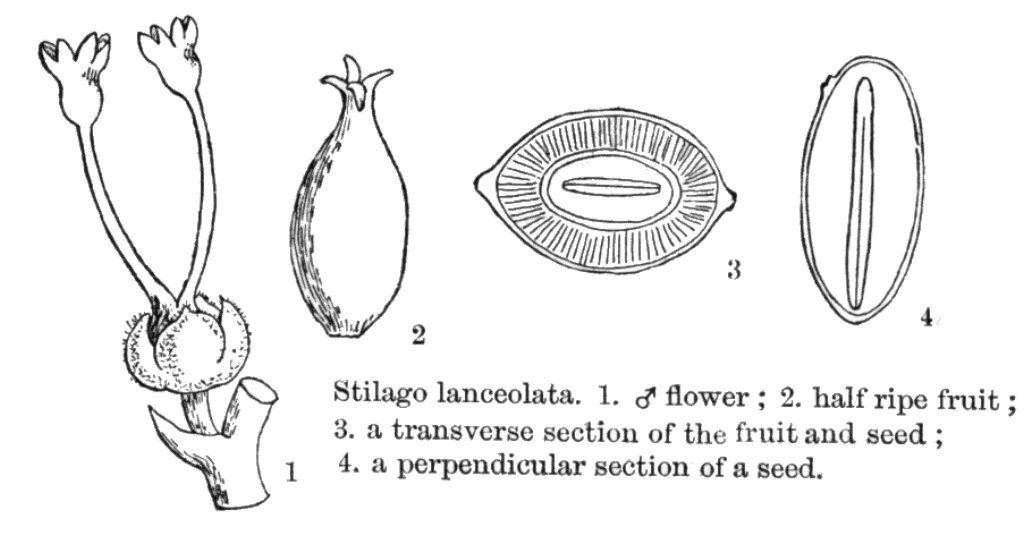
Androecium (2-)3-5(-6). Androecial members free of the perianth; free of one another. Androecium in male flowers, exclusively of fertile stamens. Stamens (2-)3-5(-6); isomerous with the perianth; oppositisepalous; inflexed in bud (the filaments inflexed); filantherous (the filaments long and filiform). Anthers dehiscing transversely (or transversly and apically); bilocular (the thecae divergent, almost free, borne on a short thick connective). Pollen grains aperturate; 3 - aperturate; colporate.
Gynoecium ostensibly 1. Carpels reduced in number relative to the perianth. Gynoecium syncarpous (pseudomonomerous); synstylovarious; superior. Ovary 1 locular. Gynoecium stylate. Styles 1; apical to lateral (subterminal); shorter than the mature ovary (short). Stigmas 2-4 (short, spreading). Placentation apical. Ovules in the single cavity 2; pendulous.
Fruit fleshy; indehiscent; a drupe (small, ovoid or flattened, often oblique, with conspicuous foveolate-reticulate endocarp and often a lateral, persistent style); 1-2 seeded. Seeds endospermic (the endosperm fleshy). Embryo well differentiated. Cotyledons 2. Embryo chlorophyllous; straight.
Geography, cytology. Paleotropical. Sub-tropical to tropical. Palaeotropical and subtropical, Africa and Asia.
Taxonomy. Subclass Dicotyledonae; Crassinucelli. Dahlgren's Superorder Malviflorae; Euphorbiales (?). Cronquist's Subclass Rosidae; Euphorbiales. Takhtajan's Subclass Dilleniidae; Malvanae; Euphorbiales. Species 170. Genera 1; only genus, Antidesma (Stilago).
Illustrations. stila259.gif