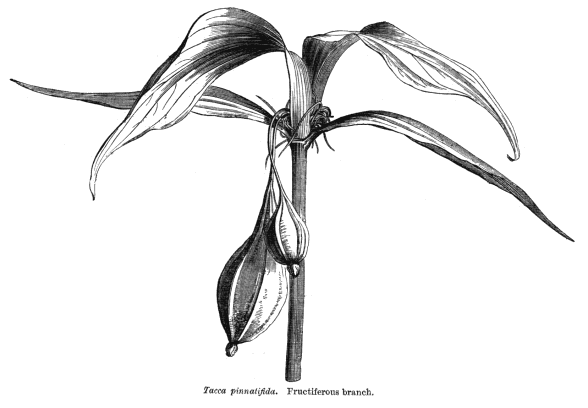
Habit and leaf form. Herbs. Perennial; with a basal aggregation of leaves (and acaulescent); rhizomatous, or tuberous (starchy). Mesophytic. Leaves alternate; spiral; petiolate; more or less sheathing. Leaf sheaths not tubular; with free margins. Leaves simple (usually), or compound. Lamina dissected, or entire; when entire lanceolate, or ovate; when dissected (i.e. occasionally) pinnatifid, or palmately lobed (or bifid); pinnately veined, or palmately veined; cross-venulate.
General anatomy. Accumulated starch other than exclusively `pteridophyte type'.
Leaf anatomy. Stomata present; anomocytic, or axillocytic.
Minor leaf veins without phloem transfer cells. Vessels absent.
Stem anatomy. Secondary thickening absent. Xylem without vessels. Sieve-tube plastids P-type; type II.
Root anatomy. Roots with velamen (single layered), or without velamen. Root xylem without vessels (`vessel tracheids').
Reproductive type, pollination. Hermaphrodite. Entomophilous; via diptera.
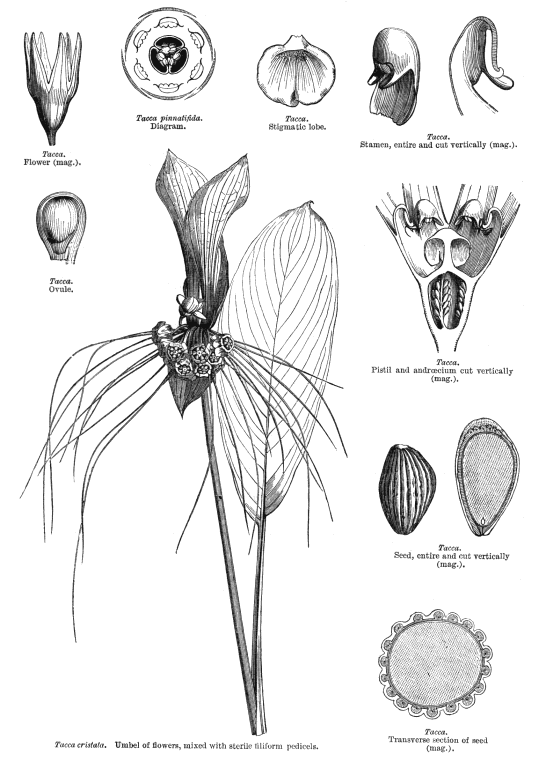
Inflorescence, floral, fruit and seed morphology. Flowers aggregated in `inflorescences'; in umbels. The terminal inflorescence unit cymose. Inflorescences pedunculate; axillary; cymose umbels; with involucral bracts (these leafy). Flowers individually bracteate (the bracts long, filiform); regular; 3 merous; cyclic; pentacyclic. Perigone tube present (campanulate).
Perianth of `tepals'; 6; joined; 2 whorled; isomerous; all more or less petaloid; similar in the two whorls; green, or purple, or brown.
Androecium 6. Androecial members adnate (to the perianth tube); free of one another; 2 - whorled. Androecium exclusively of fertile stamens. Stamens 6; diplostemonous; petaloid (the filaments adnate to the perianth except for their inflexed margins, but with a petaloid apical extension hooding the anther). Anthers adnate; non-versatile; dehiscing via longitudinal slits; introrse; bilocular; tetrasporangiate. The thickenings girdling. Anther epidermis persistent. Microsporogenesis simultaneous. The initial microspore tetrads tetrahedral. Anther wall initially with more than one middle layer (2); of the `dicot' type. Tapetum glandular. Pollen shed as single grains. Pollen grains aperturate; 1 - aperturate; sulcate; 2-celled.
Gynoecium 3; partly petaloid. Carpels isomerous with the perianth. Gynoecium syncarpous; eu-syncarpous; inferior. Ovary 1 locular. Epigynous disk present, or absent. Gynoecium stylate. Styles 1; apical. Stigmas 1; 3 - lobed (the lobes petaloid); dry type; papillate; Group II type. Placentation parietal. Ovules in the single cavity 15-100 (`many'); pendulous; non-arillate; anatropous to campylotropous; bitegmic; crassinucellate. Outer integument not contributing to the micropyle. Embryo-sac development Polygonum-type. Polar nuclei fusing prior to fertilization. Antipodal cells formed; 3; not proliferating; ephemeral. Synergids pear-shaped. Endosperm formation nuclear.
Fruit dehiscent, or indehiscent; a capsule, or a berry. Seeds endospermic. Endosperm oily. Seeds without starch. Embryo well differentiated (small). Cotyledons 1.
Physiology, biochemistry. Not cyanogenic. Alkaloids present (lactone, 2 species). Proanthocyanidins absent. Flavonols absent. Ellagic acid absent.
Geography, cytology. Holarctic, Paleotropical, Neotropical, and Australian. Sub-tropical to tropical. Pantropical. N = 15.
Taxonomy. Subclass Monocotyledonae. Superorder Liliiflorae; Dioscoreales. Species 31. Genera 1; only genus, Tacca.
Illustrations. tacca780.gif tacca781.gif