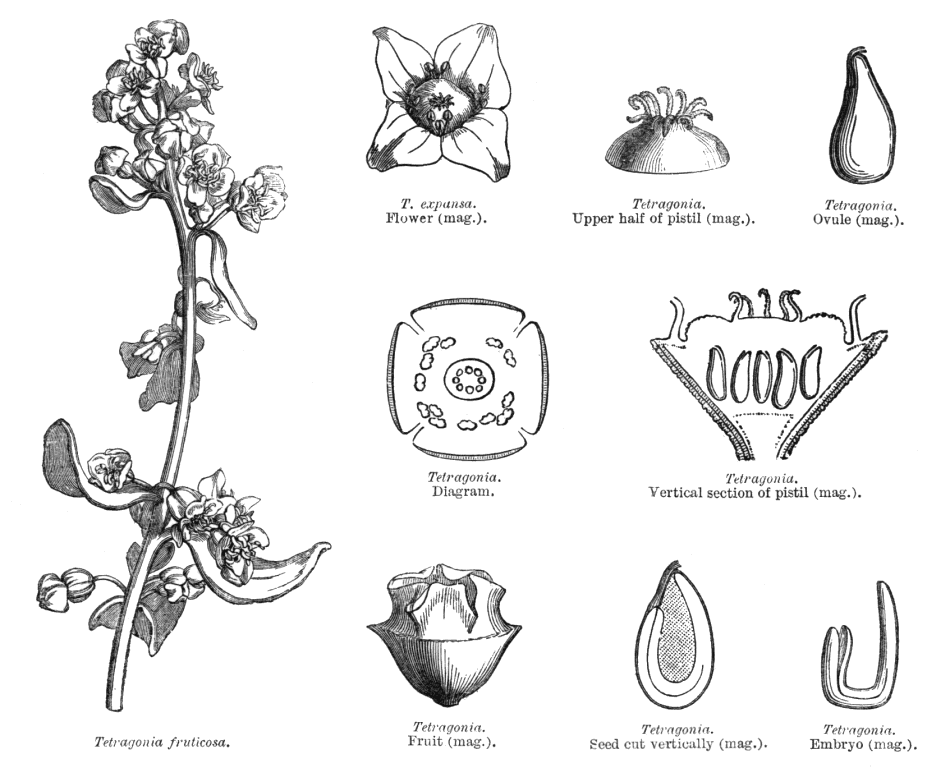
~ Aizoaceae
Habit and leaf form. Sub- shrubs and herbs. Plants succulent; autotrophic. Self supporting, or climbing; some scrambling. Mesophytic, or xerophytic. Leaves alternate; spiral; leathery; petiolate; non-sheathing; simple. Lamina entire; pinnately veined; cross-venulate. Leaves exstipulate. Lamina margins entire.
Leaf anatomy. Stomata present; anomocytic.
Minor leaf veins without phloem transfer cells (Tetragonia).
Stem anatomy. Sieve-tube plastids P-type; type III (a).
Reproductive type, pollination. Hermaphrodite, or monoecious, or polygamomonoecious (?).
Inflorescence, floral, fruit and seed morphology. Flowers solitary, or aggregated in `inflorescences'; in cymes and in racemes. The terminal inflorescence unit cymose. Inflorescences not scapiflorous; few flowered, or racemiform cymes. Flowers small; regular; 3-5 merous. Free hypanthium present (continuous with and textured like the calyx).
Perianth sepaline (but coloured inside); 3-5(-7); joined; 1 whorled; persistent; accrescent. Calyx (the perianth being so interpreted) 3-5(-7); 1 whorled; gamosepalous; regular; fleshy (at least when young, coloured within); persistent; accrescent; induplicate valvate.
Androecium 1-100 (to `many'). Androecial members branched, or unbranched; adnate (to the perianth tube); free of one another, or coherent (sometimes fasciculate); 1 - adelphous, or 2-5 - adelphous (?). Androecium exclusively of fertile stamens. Stamens 1-35; reduced in number relative to the adjacent perianth to polystemonous; alternisepalous (or at least, the staminal groups oppositipetalous). Anthers dehiscing via longitudinal slits; bilocular. Pollen grains aperturate; 3 - aperturate; colpate or colporoidate?.
Gynoecium (1-)3-8(-10). Carpels isomerous with the perianth, or reduced in number relative to the perianth, or increased in number relative to the perianth. Gynoecium syncarpous; synovarious; partly inferior, or inferior. Ovary (1-)3-8(-10) locular. Styles (1-)3-8(-10); free. Placentation axile, or apical. Ovules 1 per locule; shortly funicled; pendulous; with dorsal raphe; hemianatropous.
Fruit fleshy to non-fleshy; indehiscent; a drupe (sometimes winged or spiny, crowned by the accrescent perianth). Seeds endospermic. Embryo achlorophyllous (1/1); curved.
Physiology, biochemistry. Plants accumulating free oxalates. C3 and CAM. C3 recorded in Tetragonia reduplicata. CAM recorded in Tetragonia reduplicata.
Geography, cytology. Mostly Southern hemisphere.
Taxonomy. Subclass Dicotyledonae; Crassinucelli. Dahlgren's Superorder Caryophylliflorae; Caryophyllales. Cronquist's Subclass Caryophyllidae; Caryophyllales. Takhtajan's Subclass Caryophyllidae; Caryophyllanae; Caryophyllales. Species 60. Genera 2; Tetragonia, Tribulocarpus.
Economic uses, etc. Tetragonia expansa is used as table greens (New Zealand spinach).
Illustrations. tetra464.gif