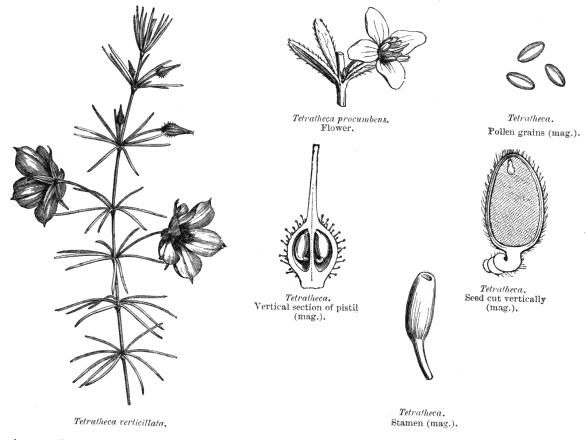
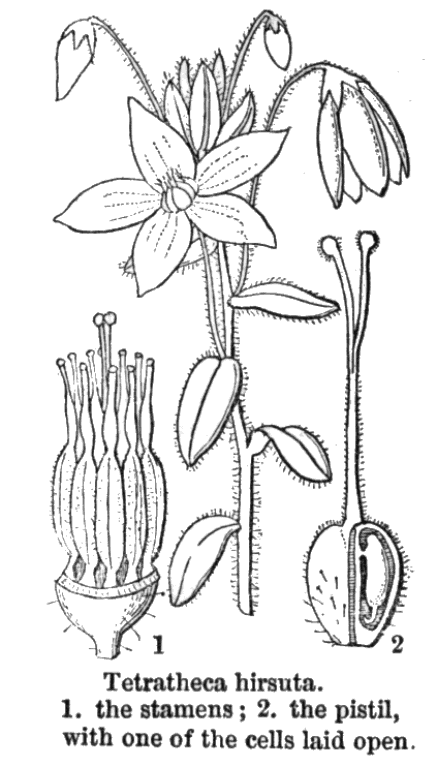
Alternatively Tremandr(ac)eae R. Br.
Habit and leaf form. Small shrubs, or herbs (slender subshrubs, or subherbaceous). `Normal' plants, or switch-plants; sometimes with the principal photosynthesizing function transferred to stems. Leaves well developed, or much reduced, or absent. Perennial. Mesophytic, or xerophytic. Leaves minute, or small; alternate, or opposite, or whorled; flat, or rolled (often ericoid); `herbaceous', or leathery, or membranous; imbricate (often), or not imbricate; petiolate to sessile; non-sheathing; simple. Lamina entire; one-veined, or pinnately veined; cross-venulate, or without cross-venules. Leaves exstipulate. Lamina margins entire, or dentate. Leaves without a persistent basal meristem.
Leaf anatomy. Mucilaginous epidermis present, or absent. Stomata present; mainly confined to one surface (abaxial); anomocytic.
Lamina dorsiventral. The mesophyll containing calcium oxalate crystals. The mesophyll crystals druses, or solitary-prismatic.
Stem anatomy. Nodes unilacunar. Secondary thickening developing from a conventional cambial ring. Xylem with libriform fibres; with vessels. Vessel end-walls simple, or scalariform and simple. Primary medullary rays narrow. Wood parenchyma scanty paratracheal (or absent).
Reproductive type, pollination. Hermaphrodite.
Inflorescence, floral, fruit and seed morphology. Flowers solitary (slender-pedicellate); small; regular; (3-)4 merous, or 5 merous; cyclic; tetracyclic (if the stamens are interpreted as one whorl). Free hypanthium absent. Hypogynous disk present, or absent.
Perianth with distinct calyx and corolla; 6, or 8, or 10; 2 whorled; isomerous. Calyx (3-)4-5; 1 whorled; polysepalous (usually), or gamosepalous; regular; valvate; with the odd member posterior. Corolla (3-)4-5; 1 whorled; polypetalous; induplicate valvate; regular; white, or pink, or purple.
Androecium 6 (rarely), or 8, or 10. Androecial members branched (this being a reasonable interpretation of the antepetalous pairs), or unbranched (as conventionally interpreted); free of the perianth; free of one another, or coherent; 4 - adelphous, or 5 - adelphous (interpreting the pairs as `bundles'); 1 - whorled (seemingly, though twice the corolla in number). Androecium exclusively of fertile stamens. Stamens 6 (rarely), or 8, or 10; diplostemonous; alternisepalous (in antepetalous pairs); filantherous (with short filaments). Anthers basifixed; non-versatile; dehiscing via pores (a single apical pore); extrorse; said to be bilocular, or four locular (and to aid morphological interpretaion of the androecium, it would be interesting to to have information on the numbers and location of the sporangia). Pollen grains aperturate; 3 - aperturate; colporate (or colporoidate); 2-celled.
Gynoecium 2. Carpels reduced in number relative to the perianth. Gynoecium syncarpous; eu-syncarpous; superior. Ovary 2 locular. Gynoecium median; stylate. Styles 1; apical. Placentation axile, or apical. Ovules 1-2 per locule; pendulous; with ventral raphe; arillate (usually), or non-arillate; anatropous; bitegmic; crassinucellate. Outer integument contributing to the micropyle. Antipodal cells formed; 3; not proliferating.
Fruit non-fleshy; dehiscent; a capsule. Capsules loculicidal, or septicidal and loculicidal. Seeds endospermic; winged (via a twisted appendage), or wingless. Cotyledons 2 (?). Embryo straight.
Seedling. Germination phanerocotylar.
Physiology, biochemistry. Cyanogenic, or not cyanogenic. Alkaloids present, or absent (2 species listed). Iridoids absent. Proanthocyanidins absent. Flavonols present; quercetin and myricetin. Ellagic acid present (Tetratheca), or absent (Platytheca). Aluminium accumulation not found.
Geography, cytology. Temperate to tropical. Australia.
Taxonomy. Subclass Dicotyledonae; Crassinucelli. Dahlgren's Superorder Araliiflorae (?); Pittosporales (?). Cronquist's Subclass Rosidae; Polygalales. Takhtajan's Subclass Rosidae; Rutanae; Polygalales. Species 25. Genera 3; Platytheca, Tetratheca, Tremandra.
Illustrations. trema251.gif trema374.gif
Additional, to be intercalated. Flowers axillary.