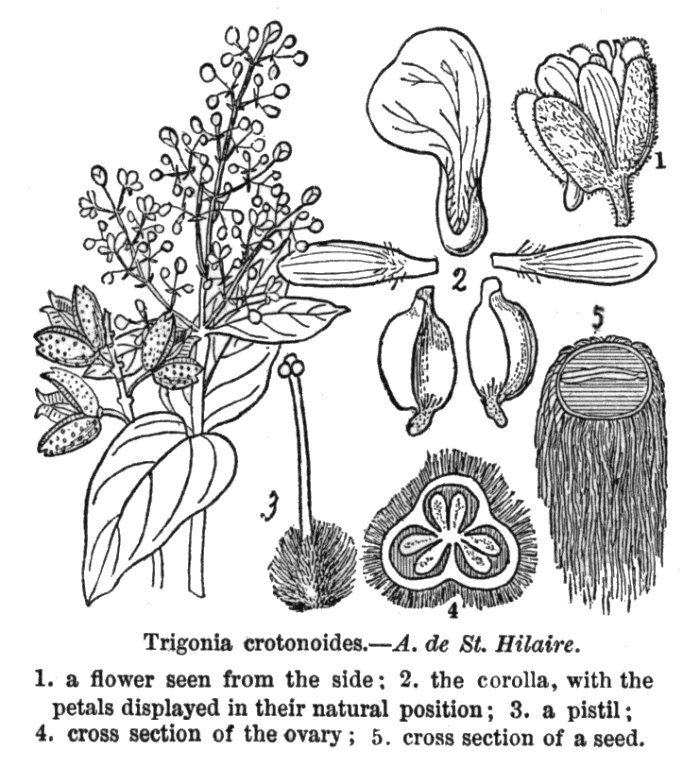
Habit and leaf form. Trees, or shrubs, or lianas. Self supporting, or climbing. Leaves opposite (usually), or alternate (Trigoniastrum); simple. Lamina entire; pinnately veined. Leaves stipulate. Stipules interpetiolar; (those of opposite leaves) often concrescent; caducous.
Leaf anatomy. Mucilaginous epidermis often present. Stomata present; mainly confined to one surface (abaxial); paracytic.
Adaxial hypodermis sometimes present. Lamina dorsiventral. The mesophyll containing mucilage cells (in the hypodermis), or not containing mucilage cells.
Stem anatomy. Cork cambium present; initially superficial. Medullary bundles present (?), or absent. Internal phloem absent. Secondary thickening developing from a conventional cambial ring. Xylem with tracheids. Vessel end-walls simple, or scalariform and simple. Wood parenchyma apotracheal, or apotracheal and paratracheal.
Reproductive type, pollination. Hermaphrodite. Entomophilous.
Inflorescence, floral, fruit and seed morphology. Flowers aggregated in `inflorescences'; in cymes, or in racemes, or in panicles (or thyses). The terminal inflorescence unit cymose. Inflorescences terminal, or axillary; various, partly or wholly cymose. Flowers bi- or tri- bracteolate; very irregular; obliquely zygomorphic. The floral asymmetry involving the perianth and involving the androecium. Flowers `pseudo-papilionaceous' (the posterior `standard' interior); cyclic. Free hypanthium present (slight), or absent. Hypogynous disk present; of separate members (in the form of (1)2-3 glands, usually adjoining the slit in the staminal tube).
Perianth with distinct calyx and corolla; 8, or 10; 2 whorled; isomerous, or anisomerous. Calyx 5; 1 whorled; gamosepalous; unequal but not bilabiate; imbricate; with the odd member posterior. Corolla 3, or 5; 1 whorled; polypetalous; imbricate, or contorted, or valvate (rarely, or subimbricate); unequal but not bilabiate (the petals usually 5, the two anterior (lower, outer) members forming an often saccate keel, the posterior (inner, upper) one forming a basally usually saccate or spurred standard, the two laterals forming flat, spathulate wings); spurred (sometimes, via the standard), or not spurred.
Androecium 5-12. Androecial members free of the perianth; markedly unequal; coherent (unilateral on the anterior side of the flower, joined by their filaments); 1 - adelphous (the long or short staminal tube split posticously); 1 - whorled. Androecium including staminodes (usually), or exclusively of fertile stamens (sometimes). Staminodes when present, i.e. usually (1-)3-6. Stamens 5-8; isomerous with the perianth to diplostemonous. Anthers dehiscing via longitudinal slits. Pollen grains aperturate; 3-5 - aperturate; porate.
Gynoecium 3(-4). Carpels reduced in number relative to the perianth. Gynoecium syncarpous; eu-syncarpous; superior. Ovary 1-3(-4) locular. Gynoecium stylate. Styles 1; apical. Stigmas 1 (simple); capitate. Placentation when unilocular, parietal (with deeply intruded placentas); axile. Ovules in the single cavity when unilocular, 2-6 (?); when plurilocular, 1-20 per locule (to `rather numerous'); pendulous to ascending; often biseriate; anatropous; bitegmic; crassinucellate. Outer integument contributing to the micropyle.
Fruit non-fleshy; dehiscent, or indehiscent; a capsule (usually), or a samara (three winged, in Humbertiodendron and Trigoniastrum). Capsules when capsular, septicidal. Seeds non-endospermic; conspicuously hairy (usually, long-pilose), or not conspicuously hairy. Embryo well differentiated. Cotyledons 2 (thin, flat). Embryo straight (usually or always transverse?).
Seedling. Germination phanerocotylar.
Physiology, biochemistry. Aluminium accumulation not found.
Geography, cytology. Paleotropical and Neotropical. Tropical. Madagascar, Southeast Asia, Central and tropical South America. N = about 10.
Taxonomy. Subclass Dicotyledonae; Crassinucelli. Dahlgren's Superorder Rutiflorae; Polygalales. Cronquist's Subclass Rosidae; Polygalales. Takhtajan's Subclass Rosidae; Rutanae; Polygalales. Species 35. Genera 4; Humbertiodendron, Trigonia, Trigoniastrum, Trigoniodendron.
Illustrations. trigo376.gif