Excluding Cymodoceaceae
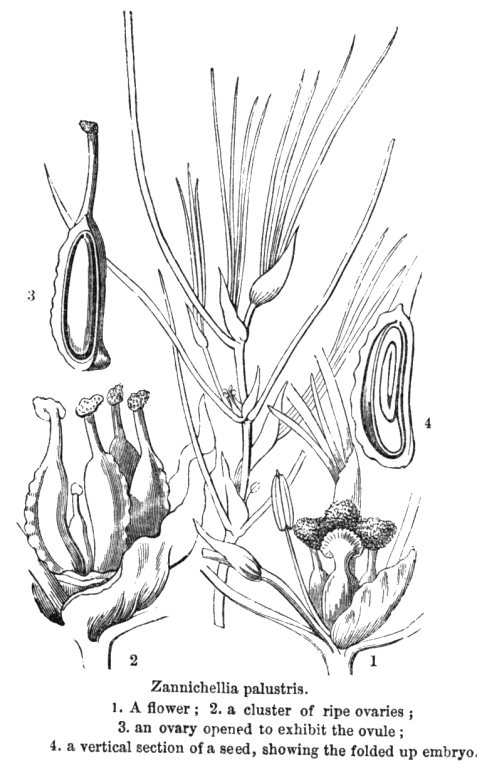
Habit and leaf form. Aquatic herbs. `Normal' plants (more or less), or plants of very peculiar form; sometimes filamentous (Chara-like). Perennial; with neither basal nor terminal aggregations of leaves; rhizomatous. Hydrophytic; non-marine (in brackish and alkakine water, not the sea); rooted. Leaves submerged. Leaves alternate (to almost opposite), or whorled (Zannichellia); usually distichous; `herbaceous', or membranous; sessile; sheathing, or sheathing and non-sheathing (Zannichellia having non-sheathing, pseudowhorled blades, and also scale-leaves corresponding to sheaths). Leaf sheaths not tubular; with free margins. Leaves simple. Lamina entire; linear; one-veined, or parallel-veined (then with 3 veins); without cross-venules. Leaves ligulate. Axillary scales present (two per node).
Leaf anatomy. The mesophyll without calcium oxalate crystals. Minor leaf veins without phloem transfer cells (Zannichellia). Vessels absent.
Stem anatomy. Secondary thickening absent. Xylem without vessels (the vascular system much reduced).
Root anatomy. Root xylem without vessels.
Reproductive type, pollination. Monoecious (usually), or dioecious. Gynoecium of male flowers absent. Pollinated by water.
Inflorescence, floral, fruit and seed morphology. Flowers aggregated in `inflorescences'; in cymes. The terminal inflorescence unit cymose. Inflorescences terminal; complex cymose aggregates. Flowers small. Perigone tube absent. Hypogynous disk absent.
Perianth vestigial (in the form of a small, trilobate basal structure), or absent; 3; joined; 1 whorled.
Androecium 1 (always, ostensibly), or 2-3 (forms with 8 or 12 microsporangia perhaps representing 2 and three concrescent anthers). Androecial members coherent (if the androecium comprises more than one stamen), or free of one another. Androecium exclusively of fertile stamens. Stamens 1, or 2-3 (depending on interpretation). Anthers unilocular, or bilocular; tetrasporangiate, or multisporangiate (4, 8 or 12 sporangia, affording evidence of coalesced anthers?); appendaged (by terminal projection of the connective), or unappendaged. Microsporogenesis successive. Tapetum amoeboid. Pollen grains nonaperturate; 3-celled.
Gynoecium 1-9; monomerous, or apocarpous; of one carpel, or eu-apocarpous; superior. Carpel stylate; apically stigmatic; 1 ovuled. Placentation apical. Ovules pendulous; non-arillate; orthotropous to anatropous; bitegmic; crassinucellate. Embryo-sac development Allium-type. Polar nuclei fusing prior to fertilization. Antipodal cells formed; 3; proliferating (forming 4 or five cells), or not proliferating. Endosperm formation helobial. Embryogeny caryophyllad.
Fruit non-fleshy; multiple, or not multiple. The fruiting carpel dehiscent, or indehiscent; an achene (usually), or a follicle (Althenia). Seeds non-endospermic. Cotyledons 1. Embryo achlorophyllous (Zannichellia palustris); coiled.
Geography, cytology. Frigid zone to tropical. Lacking only from central Eurasia, central Africa and Northeast South America. X = 6-8.
Taxonomy. Subclass Monocotyledonae. Superorder Alismatiflorae; Zosterales. Species 6. Genera 4; Althenia, Lepilaena, Pseudalthenia, Vleisia, Zannichellia.
Illustrations. zanni143.gif