![An Australian Government Initiative [logo]](/images/austgovt_brown_90px.gif)



Classification
Relationships that are and are not
|
|
In the majority of cases, similar macroscopic appearances indicate close relationships
– but there are exceptions. It is clear that convergent evolution has led
to fungi of different lineages producing fruiting bodies of similar form. In
fact, nature can sometimes produce the same solution to the same problem in
vastly different organisms. Here's an extreme example. The following photos
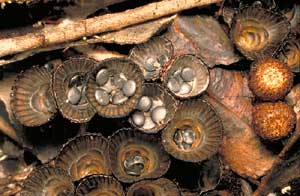
show the fruiting body of the Bird's Nest Fungus Cyathus novae-zelandiae
and a sloping-sided structure (called a gemma cup)
on a species of the liverwort genus Marchantia  . Liverworts have chlorophyll, produce simple sugars via photosynthesis
and belong to the Plant Kingdom. Notice that the fungal fruiting body and the
gemma cup both contain small "eggs". The sloping sides of both structures help
raindrops splash the "eggs" out of the respective containers. Two organisms,
from different kingdoms have produced the same solution to the problem of dispersing
the "eggs". A major difference between the egg-like objects in the two organisms is that those of Marchantia are asexual propagules whereas those of Cyathus contain sexual spores.
. Liverworts have chlorophyll, produce simple sugars via photosynthesis
and belong to the Plant Kingdom. Notice that the fungal fruiting body and the
gemma cup both contain small "eggs". The sloping sides of both structures help
raindrops splash the "eggs" out of the respective containers. Two organisms,
from different kingdoms have produced the same solution to the problem of dispersing
the "eggs". A major difference between the egg-like objects in the two organisms is that those of Marchantia are asexual propagules whereas those of Cyathus contain sexual spores.
The Inkcap example was given on the introductory CLASSIFICATION page. The phenomenon of mushroom caps dissolving into an inky mess is very striking and also rare. It was once taken as proof of a very close evolutionary relationship between the species involved. However, more recent research that the species are not as evolutionary close as once thought. Similarly there are a number of basidiomycete genera in which the fruiting bodies produce powdery spores. However, if you look at all the available evidence, the conclusion is that there is not a single evolutionary lineage that contains all the powdery spored basidiomycetes and nothing but the powdery spored ones.
|
|
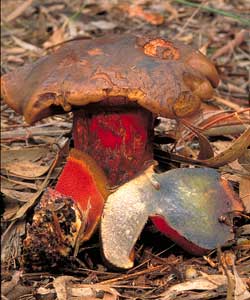 |
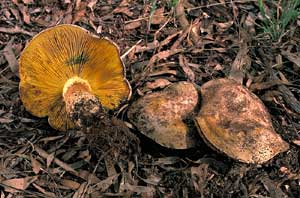
A few mushroom genera are very closely related to the boletes - rather than to other mushroom genera. Look at this Phylloporus and notice how it has stained blue where it has been bruised. That’s a bit like the bolete where the flesh turns blue when cut. In fact, if you look at the spores and tissue structure in Phylloporus you find close microscopic similarities with the boletes and Phylloporus is now classed with the boletes.
Lentinus sajor-caju
has a stem, cap and gills, much like a mushroom. Yet an
examination of the spores and hyphae show that this fungus is more closely related
to the polypores than it is to other mushrooms.
|
|
|
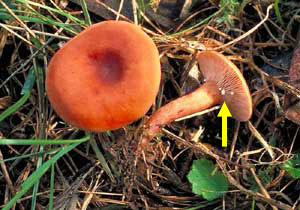
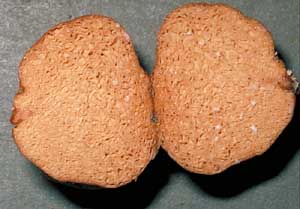
On the left is a species of Lactarius, a mushroom, that bleeds
a white fluid when cut. On the right is a species of Zelleromyces,
a basidiomycete truffle-like fungus, that bleeds a white fluid when cut. Coincidence?
Not in this case. It turns out that the two genera are very closely related.
There's more about the relationships of the truffle-like fungi in the TRUFFLE PAGE
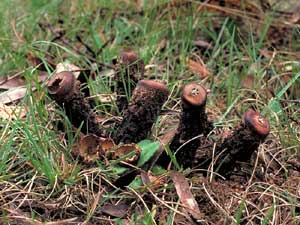
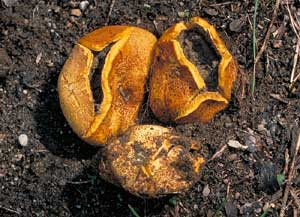
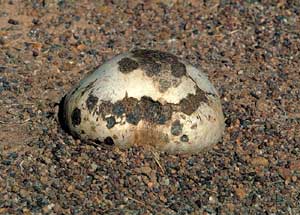
The fruiting bodies in the genus Calostoma consist of a spherical
case, filled with powdery spores, atop a braided and initially somewhat gelatinous
stalk. There has always been some argument about Calostoma's relatives,
but the genus was mostly considered to be some sort of puffball 'relative',
with Scleroderma and Pisolithus likely to be the closest genera,
though one school of thought had it connected to the stinkhorns. Recent
DNA evidence supports the closeness of Calostoma, Scleroderma
and Pisolithus - but then puts these three much closer to the fleshy,
mushroom-like (but spongy-pored)  boletes
than to any other powdery-spored 'puffball-type' fungi.
boletes
than to any other powdery-spored 'puffball-type' fungi.
|
|
|
|
|
|
|
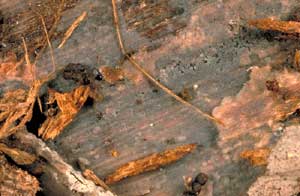
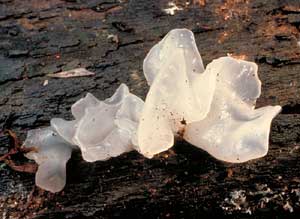
The corticioid fungi are mostly flat and often featureless - but they show a variety of evolutionary lineages. The basidia of most of the corticioid fungi lack septa. The genus Exidiopsis, with flat and featureless fruiting bodies, has septate basidia and is in fact more closely related to the convoluted jelly fungi (such as the genus Tremella ) than it is to the bulk of the corticioid fungi.