![An Australian Government Initiative [logo]](/images/austgovt_brown_90px.gif)



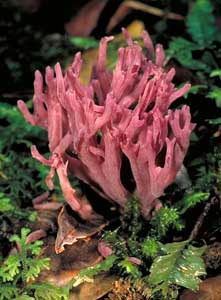 a coral fungus Clavaria zollingeri |
Types of fungal fruiting bodies (or sporocarps)
Coral and jelly fungi
Coral fungi, usually found on soil but sometimes on rotting wood, may be simple fleshy clubs or intricately branched coral-like forms in various colours (e.g. white, yellow, brown, orange, purple). Generally they are no more than a few centimetres in height but some species may grow 15-20 centimetres tall. Shown here is Clavaria zollingeri, found in damp forests.
Below are links to PDFs of two illustrations of coral fungi taken from Scottish Cryptogamic Flora, by Robert Kaye Greville and published in instalments from 1822 to 1826. In each case I'll give first the species name used by Greville and, in brackets, the current name for that species. You can see views of the fruiting bodies as well as illustrations of spores in asci. At this time it was believed that all macrofungi produced their spores in asci. These fungi are basidiomycetes yet the illustrations show spores in asci, an excellent example of reality not being allowed to get in the way of belief!
Clavaria abietina (Ramaria abietina). Figure 4 shows spores in asci.
Clavaria rugosa (Clavulina rugosa). Figure 3 shows spores and asci.
The illustrations were printed in black-and-white and then coloured by hand. These particular copies were not for sale but were used as examples for the colourists to follow. At the bottom of the Clavaria abietina plate you can see a hand-written instruction telling the colourist to be careful with the shading between the branches, so as to get the perspective right.
Jelly-fungi look like gelatinous blobs and grow on rotting wood. They
are generally quite rubbery in consistency, surprisingly robust and include
white, yellow and brown species. They vary in size from a few millimetres to
several centimetres in diameter. Two common species are the white Tremella
fuciformis  and the yellow to orange Tremella mesenterica below.
Possibly the most striking paintings of the jelly fungi are those by Ella Neuhoff. These appeared in Walther Neuhoff's Die Gallertpilze (Tremellinae) which was published in several fascicules between 1934 and 1937 and constituted Volume 2a of Die Pilze Mitteleuropas. 'Gallert' is a German word for jelly and 'Pilze' means fungi. Each plate features from one to three species, with multiple paintings of each. Below are links to PDFs of the plates and the list of species on each, using the names by which they were known to the Neuhoffs. In the original publication the large square on each page measures 21 x 29 centimetres and the plates have a slight 'soft-focus' appearance. (note: each PDF plate is about 2,000 KB)
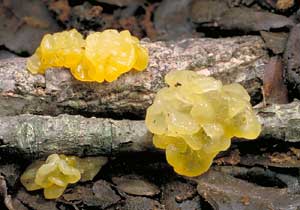 a jelly fungus Tremella mesenterica |
Plate 1: Ditangium cerasi, Exidia recisa, Exidia umbrinella
Plate 2: Exidia saccharina, Exidia repanda
Plate 3: Exidia cartilaginea, Exidia villosa
Plate 4: Exidia albida, Exidia gemmata
Plate 5: Exidia gemmata, Exidia glandulosa
Plate 6: Exidia truncata, Exidia pithya
Plate 7: Exidia grilletii, Exidia badio-umbrina, Guepinia helvelloides
Plate 8: Naematelia encephala, Tremella mesenterica
Plate 9: Tremella foliacea
There have been some taxonomic changes since the 1930s and some of the species listed above are now known by different names. These are Ditangium cerasi (now Craterocolla cerasi), Exidia gemmata (Myxarium hyalinum), Exidia grilletii (Stypella grilletii), Guepinia helvelloides (Tremiscus helvelloides) and Naematelia encephala (Tremella encephala).
The paintings are not all to the same scale and there are no scale bars on the plates. General size information about the species was given in the accompanying text. Guepinia helvelloides (Tremiscus helvelloides) can be from a few to 10 centimetres tall and Tremella mesenterica can grow to several centimetres in height. Many of the other species are more spread out in form, capable of covering many square centimetres but often only a few millimetres to a centimetre thick.