![An Australian Government Initiative [logo]](/images/austgovt_brown_90px.gif)



Two Major Groups
Classifying fungi into ascomycetes and basidiomycetes
The (macro) fungi that are dealt with in this website can be divided into two broad groups, called ascomycetes and basidiomycetes, depending on how their sexual spores are formed. All the macrofungi produce sexual spores, which result from the combination of genetic information from two parents. The function of the fruiting bodies described in the TYPES OF FUNGI SECTION is to produce and disperse sexual spores. However, many macrofungal species may also produce asexual spores - but not in such easily visible structures as those that produce the sexual spores. For the sake of brevity, the simple word "spore" will be used throughout this section but it will always mean "sexual spore", since only the sexual spores are relevant here.
Ascomycetes
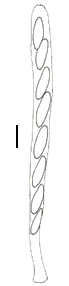
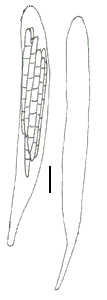
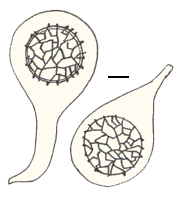
In ascomycetes the spores are produced within microscopic cells called asci. The asci vary in shape from cylindric to spherical. Commonly, each ascus holds eight spores - but there are species with just one spore per ascus and others with over a hundred spores per ascus.
Here are some drawings of asci. If you click on the camera you will see a photo of the corresponding fruiting body. To give you an idea of size, the short black line in each drawing represents a hundredth of a millimetre. Notice the one large spore per ascus in the Tuber.
 |
 |
 |
Leotia lubrica
|
Trichoglossum walteri
|
Tuber sp.
|
Of the fruiting bodies described in the TYPES OF FUNGI section, the cup (or disk) fungi and the flask fungi are ascomycetes; the truffle-like fungi include both ascomycetes and basidiomycetes. The links below will show you where the asci are found in the different types of fruiting bodies. The diagrams that will help in the explanations are stylized, often with the size of the asci exaggerated (to show them more easily).
 Despite
this, the diagrams will illustrate the nature of many of the ascomycete fruiting
bodies you are likely to see.
Despite
this, the diagrams will illustrate the nature of many of the ascomycete fruiting
bodies you are likely to see. 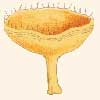 |
The fruiting bodies are typically shaped like shallow cups or saucers |
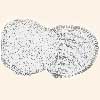 |
These produce their fruiting bodies in small chambers |
|
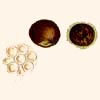 |
Truffle-like fruiting bodies are generally out of sight, underground. |
Basidiomycetes
In basidiomycetes the spores develop on projections that grow out from microscopic cells called basidia, rather than being enveloped within cells. In most cases the basidia are elongated and club-like, though there is variation in shape. Commonly, each basidium has four projections and four spores - but some species may have just one projection and spore per basidium and others up to eight. In most basidiomycetes the basidia have no dividing walls (or septa), but in a small number of genera the basidia are septate. The projections from the basidia are called sterigmata (singular: sterigma).
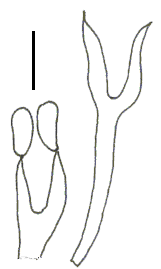
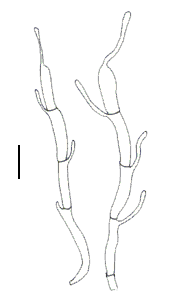
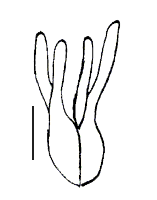
Here are some drawings of basidia from various fungi. Some basidia are shown with spores, some have already released their spores. If you click on the camera icon, you will see a photo of the corresponding fruiting body. To give you an idea of size, the short black line in each drawing represents a hundredth of a millimetre. It is not hard to see why the basidia in Dacryopinax are called "tuning-fork"basidia.
Basidia with no septa:
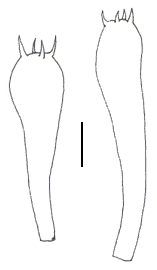 |
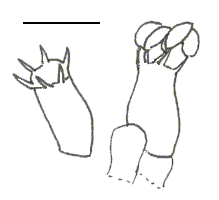 |
 |
| Amanita phalloides (the Deathcap mushroom)
|
Botryobasidium sp.
|
Dacryopinax spathularia
|
Basidia with septa:
 |
 |
| Auricularia sp
|
Tremella fuciformis
|
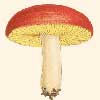
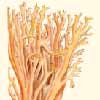
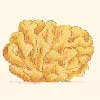
Most of the types of fruiting bodies described in the TYPES OF FUNGI section are produced by basidiomycetes. Remember that there are both ascomycete and basidiomycete truffle-like fungi. The links below will show you where the basidia are found in the different types of fruiting bodies. The diagrams that will help in the explanations are stylized, often with the size of the basidia exaggerated (to show them more easily). Despite this, the diagrams will illustrate the nature of many of the basidiomycete fruiting bodies you are likely to see.
 |
 |
|||
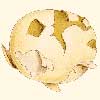 |
the puffballs, stinkhorns and birds nest fungi |
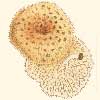 |
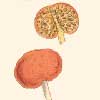
Boletes are mushroom-like, but with pores under the cap. Polypores vary from flat to mushroom-like and also have pores. |
|
 |
 |
However, while the basidiomycetes show a greater variety of fruiting body shapes, there are more ascomycete than basidiomycete species.
In other websites or books you will often see the words ascospore and basidiospore used when it is necessary to emphasize the method of spore production.