![An Australian Government Initiative [logo]](/images/austgovt_brown_90px.gif)



Two Groups - classifying fungi into ascomycetes and basidiomycetes:
Jelly fungi & Wood-ears
Tremella (right) |
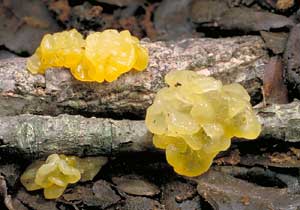 |
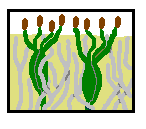
Jelly fungi
The irregularly shaped jelly fungi (such as the species of Tremella) have the basidia in the convoluted surfaces of the fruiting bodies. The basidia of the jelly fungi are septate along their long axes and have long, often weakly sinuous sterigmata. The basidia are within the gelatinous fruiting body, with only the ends of the sterigmata (and the spores) protruding into the air. The basidia and hyphae that make up the fruiting bodies are often embedded within a gelatinous matrix that can make the hyphae hard to see. In this diagram the dull yellowish colour represents the gelatinous matrix and the thick, grey, wavy lines are the hyphae of the fruiting body. As before, the basidia and spores are coloured green and brown respectively.
Possibly the most striking paintings of the jelly fungi are those by Ella Neuhoff. These appeared in Walther Neuhoff's Die Gallertpilze (Tremellinae) which was published in several fascicules between 1934 and 1937 and constituted Volume 2a of Die Pilze Mitteleuropas. 'Gallert' is a German word for jelly and 'Pilze' means fungi. Each plate features from one to three species, with multiple paintings of each. Below are links to PDFs of the plates and the list of species on each, using the names by which they were known to the Neuhoffs. In the original publication the large square on each page measures 21 x 29 centimetres and the plates have a slight 'soft-focus' appearance. (note: each PDF plate is about 2,000 KB)
Plate 1: Ditangium cerasi, Exidia recisa, Exidia umbrinella
Plate 2: Exidia saccharina, Exidia repanda
Plate 3: Exidia cartilaginea, Exidia villosa
Plate 4: Exidia albida, Exidia gemmata
Plate 5: Exidia gemmata, Exidia glandulosa
Plate 6: Exidia truncata, Exidia pithya
Plate 7: Exidia grilletii, Exidia badio-umbrina, Guepinia helvelloides
Plate 8: Naematelia encephala, Tremella mesenterica
Plate 9: Tremella foliacea
There have been some taxonomic changes since the 1930s and some of the species listed above are now known by different names. These are Ditangium cerasi (now Craterocolla cerasi), Exidia gemmata (Myxarium hyalinum), Exidia grilletii (Stypella grilletii), Guepinia helvelloides (Tremiscus helvelloides) and Naematelia encephala (Tremella encephala).
The paintings are not all to the same scale and there are no scale bars on the plates. General size information about the species was given in the accompanying text. Guepinia helvelloides (Tremiscus helvelloides) can be from a few to 10 centimetres tall and Tremella mesenterica can grow to several centimetres in height. Many of the other species are more spread out in form, capable of covering many square centimetres but often only a few millimetres to a centimetre thick.
Wood-ears
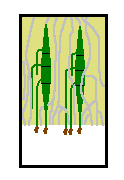 basidia in smooth, semi-glossy undersurface |
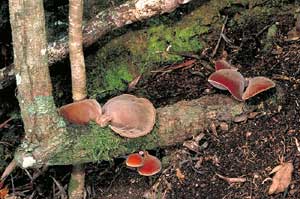 Auricularia sp. |
The fresh fruiting bodies of species in the genus Auricularia are gelatinous and somewhat ear-shaped (hence the common name of Wood Ears, for they grow on wood). The basidia are elongated, tapering at their ends and septate across their width. As in the jelly fungi, the basidia of Auricularia are within the fruiting bodies with just the ends of the sterigmata (and the spores) beyond the surface. The basidia are in the smooth, semi-glossy undersurface - not the dull, roughened to bristly upper surface. This diagram shows the arrangement in Auricularia, using the same colour code as in the preceding jelly fungus diagram.