
Australian Biological
Resources Study
Updated 23 April 2013
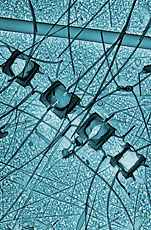
Chaetoceros cf. dichaeta
Photo: L. Armand
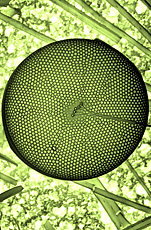
Thalassiosira poroseriata
Photo: L. Armand
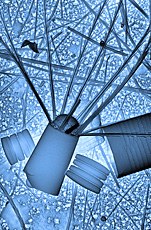
Corethron pennatum
Photo: L. Armand
Diatoms are mostly unicellular, golden brown, green or dark brown algae 2 to 200 microns in size (occasionally several millimetres long), their cell walls composed of silica with an organic coating. Found in all aquatic environments, they can be planktonic, or they can attach to substrata such as rock, sand, mud, plants and animals. At sea, diatoms contribute enormously to the microbial component of a food web that supports most other marine organisms. They also play a role in influencing climate through the exchange of carbon dioxide with the atmosphere (Scott & Marchant, 2005).
An inventory of Australian non-marine diatoms has been provided by Day et al. (1995). The current list includes 938 species and infraspecific taxa known from inshore and offshore waters around Australia and/or from estuarine and other brackish-water habitats.
Click on the links (below) to view species fact-sheets. These contain original publication details, basionyms, other synonyms relevant to Australia, broad type localities, Australian and global distributions, and literature references for Australian records. The fact-sheets have been compiled mainly from comparatively recent sources, including overviews of the diatoms of temperate Australian waters (Jameson & Hallegraeff, 2010; Saunders et al., 2010), eastern Australia (Foged, 1978), the Swan River estuary in Western Australia (John, 1983), a series of substantial papers by E.J.F. Wood and L.H. Crosby (1958–61), and the results of other taxonomic and floristic research.
For publication details, typification and extra-Australian distribution, I have relied heavily on three monumental resources, Catalogue of Diatom Names , Index Nominum Algarum and AlgaeBase , as well as numerous papers, reports and abstracts.
While this aims to be a reasonably comprehensive preliminary list, accepted names, their systematic placement and synonymy and the geographical distribution of taxa are based solely on the literature and the taxonomic judgements therein.
Notification of errors, omissions and updates will be gratefully received and acknowledged.
Patrick M. McCarthy (Retired, Australian Biological Resources Study)
See also: Census of Australian Marine Dinoflagellates
McCarthy, P.M. (2013), Census of Australian Marine Diatoms.
Australian Biological Resources Study, Canberra.
https://www.anbg.gov.au/abrs/Marine_Diatoms/index.html [version 23 April 2013].
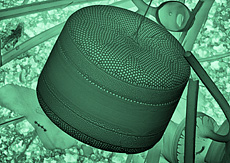
Thalassiosira poroseriata
Photo: L. Armand
I thank Brigitte Kuchlmayr for website design, Christy Geromboux for technical assistance, Catherine Jordan for library support, Leanne Armand for illustrations and literature, Fiona Scott for advice and Tony Rees for updates.
A.C.T. – Australian Capital Territory; N.S.W. – New South Wales; N.T. – Northern Territory; Qld – Queensland; S.A. – South Australia; Tas. – Tasmania; Vic. – Victoria; W.A. – Western Australia
CROSBY, L.H. & WOOD, E.J.F. (1958), Studies on Australian and New Zealand diatoms I. – Planktonic and allied species, Trans. Roy. Soc. New Zealand 85: 483–530.
CROSBY, L.H. & WOOD, E.J.F. (1959), Studies on Australian and New Zealand diatoms. II. – Normally epontic and benthic genera, Trans. Roy. Soc. New Zealand 86: 1–58.
DAY, S.A., WICKHAM, R.P., ENTWISLE, T.J. & TYLER, P.A. (1995), Bibliographic Checklist of Non-marine Algae in Australia. Flora of Australia Supplementary Series No. 4. Australian Biological Resources Study, Canberra.
FOGED, N. (1978), Diatoms in eastern Australia, Biblioth. Phycol. 41: 1–243.
JAMESON, I. & HALLEGRAEFF, G.M. (2010), Planktonic diatoms, Algae of Australia: Phytoplankton of Temperate Coastal Waters 16–82.
JOHN, J. (1983), The diatom flora of the Swan River Estuary, Western Australia, Biblioth. Phycol. 64: 1–358.
SAUNDERS, K., LANE, C., COOK, S., McMINN, A. & HALLEGRAEFF, G.M. (2010), Benthic diatoms, Algae of Australia: Phytoplankton of Temperate Coastal Waters 83–144.
SCOTT, F.J. & MARCHANT, H.J. [eds] (2005), Antarctic Marine Protists. Australian Biological Resources Study, Canberra & Australian Antarctic Division, Hobart.
WOOD, E.J.F. (1961), Studies on Australian and New Zealand diatoms. IV. – Descriptions of further sedentary species, Trans. Roy. Soc. New Zealand 88: 669–698.
WOOD, E.J.F., CROSBY, L.H. & CASSIE, V. (1959), Studies on Australian and New Zealand Diatoms. III. – Descriptions of further discoid species, Trans. Roy. Soc. New Zealand 87: 211–219.
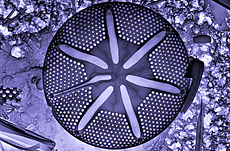
Asteromphalus parvulus
Photo: L. Armand