Systematics and Evolution (HA)
Bryophytes
Liverwort and Hornwort studies
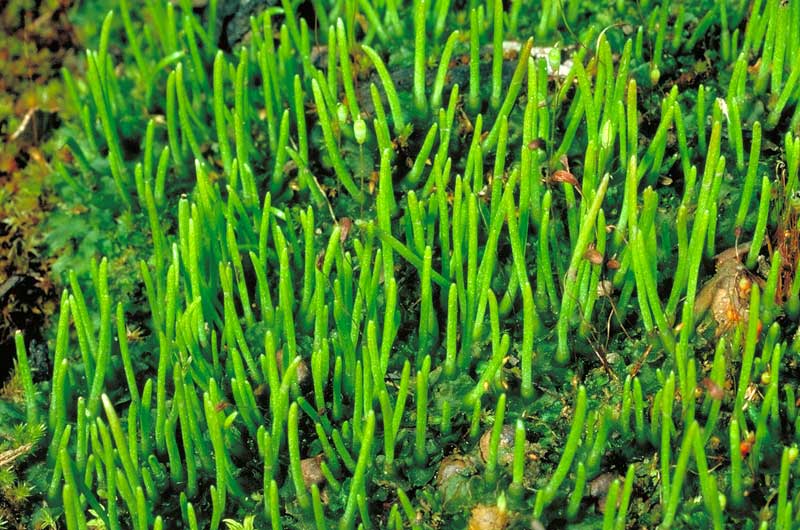
 Young sporophytes of hornwort Phaoeceros
 |
Project Leader: Christine Cargill
This is a brief introduction for those who are perhaps unfamiliar with bryophytes. The mosses, liverworts and hornworts were traditionally lumped together under the division Bryophyta, as a consequence of these plants sharing very similar habit and life cycles. In general they are small herbaceous plants with an alternating life cycle consisting of a dominant, persistent vegetative gametophyte, and a short-lived sporophyte which is nutritionally dependent upon the gametophyte. More recently they have come to be recognised as three distinct divisions or phyla, arising from three distinct ancestors. They are now known as the Bryophyta (mosses) the Marchantiophyta (liverworts) and the Anthocerotophyta (hornworts). The liverworts are in turn divided into two morphologically and developmentally distinct groups. These are the leafy liverworts, which as the name suggests possess a simple stem and two or three rows of leaves; closely related to the leafy liverworts are the simple thalloids, which in some taxa may appear leafy but many are thalloid in appearance. The second distinct group are the complex thalloids, whereby the thallus is differentiated into distinct layers with airpores on the upper surface. My research interests lie with the thalloid liverworts and the hornworts.
My previous research involved a partial revision of the simple thalloid liverwort suborder Fossombroniineae, revising the genus Fossombronia and Sewardiella for Australia, Africa, Southwest Asia (the Middle East) and the subcontinent of India. Future projects will look into the taxonomy, phylogeny and phylogeography of the genus Fossombronia as well as the suborder.
Spore patterns in some groups of liverworts and hornworts have traditionally been important in the identification of species. With the advent of molecular techniques, these characters have been tested for their reliability to predict species delimitations.
I am continuing my research within the Fossombroniineae. One of the aims of my research is to test the robustness of spore patterns in the determination of species within Fossombronia. In particular I am also interested in the biogeography of the group comparing taxa found in eastern Australia with those which appear to be conspecific in western Australia.
I am also working towards a revision of the Australian taxa of hornworts combining both morphological and molecular data. While the generic boundaries within the hornworts are becoming clearer with the increased utilization of molecular data within the group, species boundaries are still ambiguous. I am presently revising the genus Megaceros for Australasia using both morphology and molecular data.
|