Systematics and Evolution (HA)
Malvaceae
 Project Leader: L. Craven Project Leader: L. Craven
While species of Malvaceae usually are only locally dominant in Australian plant communities, the family nonetheless contributes significantly to biodiversity at both the generic and specific levels. Perhaps the best known genus of the family is Hibiscus, commonly cultivated in gardens for its showy flowers. Another significant genus is Gossypium which includes the important crop, cotton; a third of the species of this genus are endemic to Australia.
The tribe Hibisceae includes several economic plants, such as okra (Abelmoschus esculentus), kenaf (Hibiscus cannabinus) and hibiscus (H. rosa-sinensis). The taxonomy of the tribe is poorly known overall, although some groups have received attention because they contain economically important species (e.g. Abelmoschus, Hibiscus sect. Furcaria). Present research is focused upon three major areas: Hibisceae, phylogeny of Hibiscus sect. Furcaria, and floristic and taxonomic studies of selected taxa. Bernard Pfeil is re-evaluating the classification of Hibisceae using molecular and morphological data. The evolutionary relationships of the members of the tribe are of particular interest as the tribe previously has been associated with Bombacaceae and the presently recognised tribe Gossypieae. Recently obtained molecular data have indicated that Hibisceae may be paraphyletic and this will be explored further with additional sequences and morphological data. Curt Brubaker, Bernard Pfeil and Lyn Craven are collaborating with Randy Small, University of Tennessee, Knoxville, in studying the phylogeny and genome evolution of Hibiscus sect. Furcaria. This section is pan-tropical with c. 120 species of which c. 30 occur in Australia. Lyn Craven is revising the taxonomy of H. sect. Furcaria in Australia in collaboration with Doug Wilson, Tempe, and Paul Fryxell, Austin.
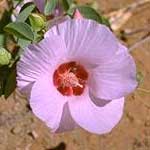
The 17 Australian species of Gossypium comprise three distinct groups recognised at sectional level within the genus, i.e. sects. Grandicalyx, Hibiscoidea and Sturtia. The three sections themselves are placed in a separate subgenus, subg. Sturtia. One species, G. sturtianum, Sturt’s Desert Rose, has been found to be both extremely variable and widespread. Its morphological and genetic variation is being studied by Curt Brubaker and Lyn Craven with the aim of explaining the evolutionary and biogeographical history of the species. Taxonomic concepts in the prostrate and semiprostrate species of sect. Grandicalyx are unclear and there is considerable overlap in morphological variation. Brubaker and Craven in collaboration with Mac Stewart, Arkansas, and Jonathan Wendel, Iowa, will use morphological and molecular data to demonstrate the evolutionary relationships within sect. Grandicalyx and devise a new taxonomy at species level.
|