![An Australian Government Initiative [logo]](/images/austgovt_brown_90px.gif)







What is a Bottlebrush?
Bottlebrushes are members of the genus Callistemon and belong to the family Myrtaceae. They are closely related to paperbark melaleucas, which also have 'bottlebrush' shaped flower spikes. It is difficult to tell to which genus some species belong. Botanists are currently closely studying these plants to determine how they are best classified. There are 40 species currently called Callistemon. 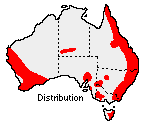 Where
do they Occur?
Where
do they Occur?
Most Bottlebrushes occur in the east and south-east of Australia. Two species
occur in the south-west of Western Australia and four species in New Caledonia.
Bottlebrushes can be found growing from Australia's tropical north to the temperate
south. They often grow in damp or wet conditions such as along creek beds or in
areas which are prone to floods.
Bottlebrush Flowers, Fruits and Leaves
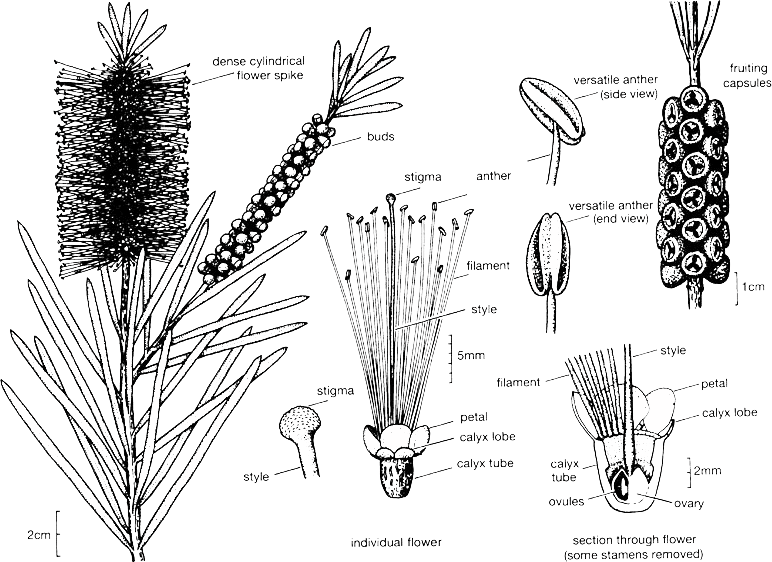
The flower spikes of bottlebrushes form in spring and summer and are made up of
a number of individual flowers. The pollen of the flower forms on the tip of a
long coloured stalk called a filament. It is these filaments which give the flower
spike its colour and distinctive 'bottlebrush' shape. The filaments are usually
yellow or red, sometimes the pollen also adds a bright yellow flush to the flower
spikes. [ drawing web view or PDF to print ]
Each flower produces a small woody fruit containing hundreds of tiny seeds. These
fruits form in clusters along the stem, and are usually held on the plant for
many years. The seeds are usually not released from the fruits for several years,
but in some species the fruits open after about a year. Fire also stimulates the
opening of the fruits in some bottlebrushes.
The new leaves of many bottlebrushes are very ornamental. The leaves are often
coloured and, in some species, they are covered with fine, soft hairs.
Bottlebrushes as Garden Plants
Bottlebrushes make excellent garden plants. Plants are all woody shrubs which
range from 0.5 m to 4 m tall. The flowers can be spectacular and are irresistible
to nectar-feeding birds and insects. Most species are frost tolerant.
The popularity of bottlebrushes as garden plants commenced soon after European
settlement and Crimson Bottlebrush (Callistemon citrinus ) was introduced
to Britain by Joseph Banks in
1789.
Many species can tolerate (or thrive in) damp conditions, yet most are very hardy
and will tolerate drought and limited maintenance. They grow well in a wide variety
of soils, except those which are highly alkaline. Plants grown in full sun produce
the best flowers.
Plants can be lightly pruned after flowering to keep them in shape. A low-phosphorous
fertiliser should be applied in spring and autumn. Mulching will help retain soil
moisture and reduce weed growth.
Many cultivars have been selected from natural variants and hybrids between species.
Some of these are very good garden plants.
Pruning
This can take the form of:
'Tip pruning' undertaken as new growth appears (bearing in mind that the next lot of flowers are formed on the end of this growth after it has hardened and therefore you may be sacrificing some flowers if you do not do this early enough), or
pruning just behind the flowers, as they are finishing, probably the preferred option unless prior to winter when subsequent new growth may be damaged by frost.
Propagation
Bottlebrushes are easily grown from seed. The unopened fruits should be collected and stored in a warm place in a paper bag until the fine seeds are released. The seed should be sown into a freely draining seed-raising mix during spring and summer.Bottlebrushes hybridise readily so, if you wish to be sure that you are preserving the features of the parent plant do not grow plants from seed, use cuttings instead. With all cultivars it is essential to propagate from cuttings to retain the form of the parent plant. Cuttings should be taken from semi-mature wood.
Commonly Grown Bottlebrushes
The following bottlebrushes grow well in most temperate parts of Australia and have been successfully cultivated at the Gardens.  Callistemon
brachyandrus - Prickly Bottlebrush
Callistemon
brachyandrus - Prickly Bottlebrush
This prickly-leaved shrub grows best in well-drained soils in full sun and is
an excellent plant for hot, dry areas. The tips of the small red flower-spikes
are covered in yellow pollen and are most attractive. The rounded shrubs grow
to about 3 m. 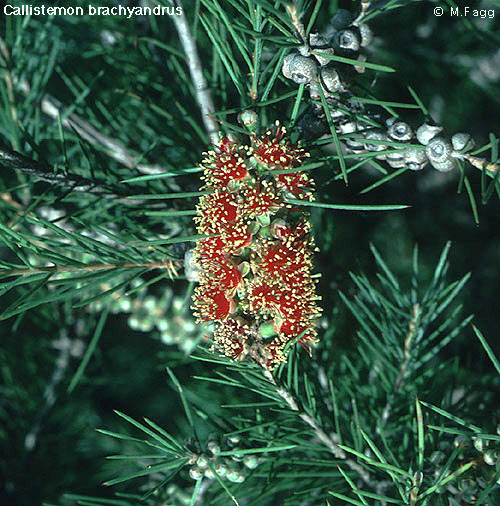
 Callistemon
citrinus - Crimson Bottlebrush
Callistemon
citrinus - Crimson Bottlebrush
This hardy shrub is probably the best known bottlebrush and is widely cultivated.
The bright red flower-spikes appear in summer and autumn. Crimson Bottlebrush
grows well in wet conditions and usually reaches 4 m. Plants should be lightly
pruned and fertilised after flowering. Neglected or mis-shapen plants respond
to hard pruning. 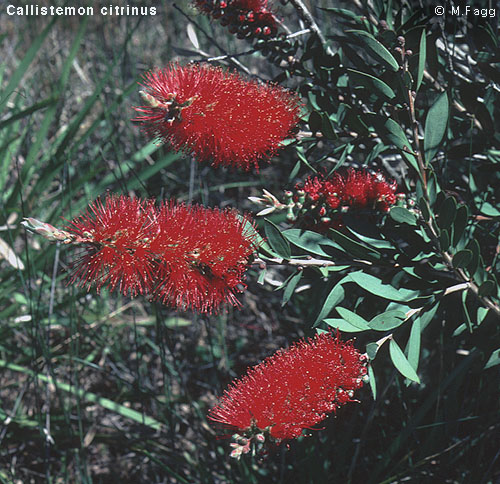
 Callistemon
formosus - Kingaroy Bottlebrush
Callistemon
formosus - Kingaroy Bottlebrush
This attractive shrub is suitable for tropical and frost-free areas. Plants grow
to 3 m tall and have weeping branches. Lemon-coloured flower spikes are produced
throughout the year. It is planted as street tree in Kingaroy, Queensland. 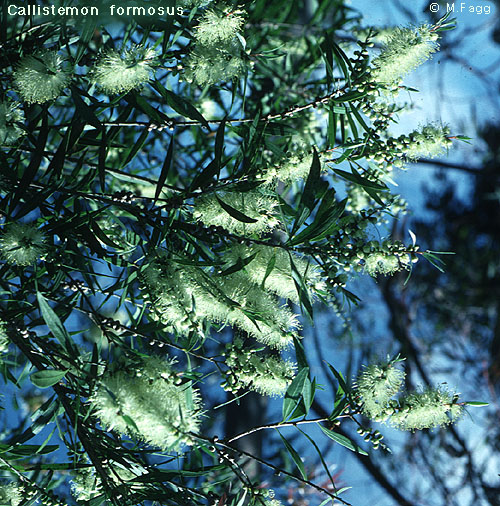
 Callistemon
pallidus - Lemon Bottlebrush
Callistemon
pallidus - Lemon Bottlebrush
A tough, frost tolerant species which grows well in most soil conditions. Plants
grow and flower best in full sun. The lemon-coloured flower spikes are produced
in summer. Plants grow to about 3 m. 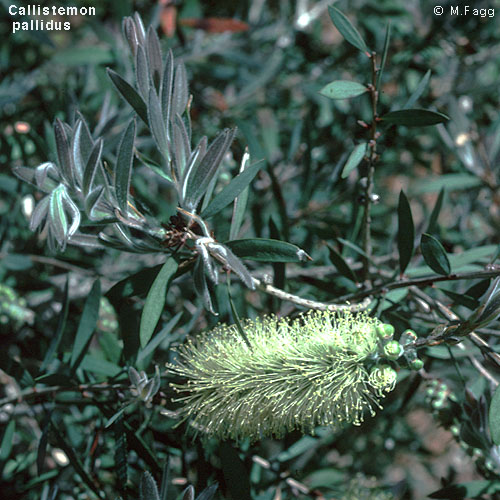
 Callistemon
pityoides - Alpine Bottlebrush
Callistemon
pityoides - Alpine Bottlebrush
This very hardy and attractive bottlebrush is available in several forms. The
alpine form is especially attractive and grows as a compact bush to about 1 m
tall. Other forms grow as erect shrubs to about 2 m. Yellow flower spikes are
produced in spring and summer. Plants grow best in moist soils. Alpine Bottlebrush
can withstand heavy pruning if required. It is frost hardy. 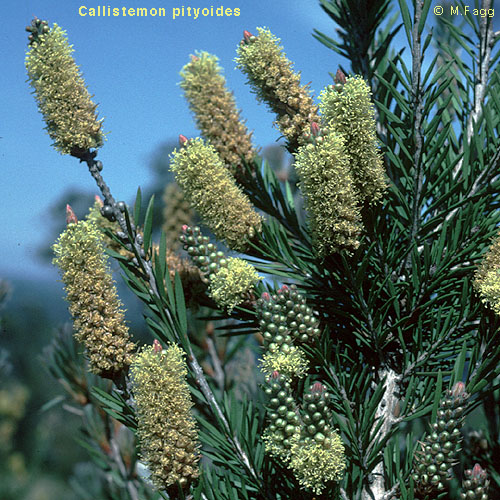
 Callistemon
salignus - Willow Bottlebrush
Callistemon
salignus - Willow Bottlebrush
This small tree has attractive narrow foliage and white papery bark. It is drought
resistant and quite hardy, although it can be affected by the frost in cold climates.
The flower-spikes are generally white or greenish but pink, red and mauve forms
can be found. An excellent garden and street tree which grows 5 to 12 m tall. 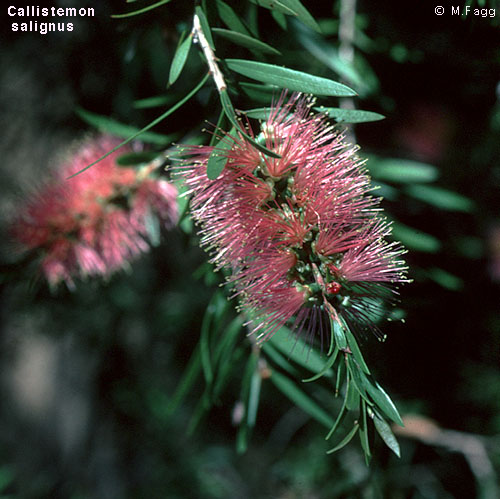
 Callistemon
subulatus
Callistemon
subulatus
This compact shrub grows from 1 to 3 m tall and is able to tolerate quite wet
conditions. Callistemon subulatus is a freely flowering plant which produces
red flower spikes over summer. Light pruning after flowering will keep the shrub
compact. 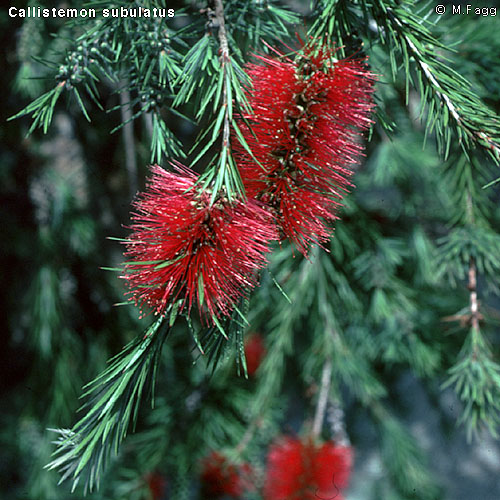
 Callistemon
viminalis - Weeping Bottlebrush
Callistemon
viminalis - Weeping Bottlebrush
This large bottlebrush is widely cultivated. Plants produce bright red flower
spikes which are very rich in nectar and attract many birds. Plants grow in a
variety of soils, but can be frost tender, especially when young. Weeping Bottlebrush
grows 5 to 7 m tall.

Callistemon cultivars
A large number of bottlebrush cultivars have been developed, many of them hybrids with either Callistemon viminalis or Callistemon citrinus as one parent.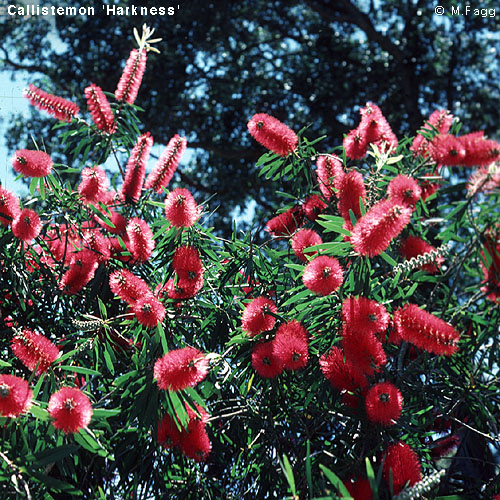 Callistemon 'Harkness', Callistemon 'Hannah Ray' and Callistemon 'Dawson River Weeper' are large shrubs growing 4 to 5 m tall. All have an
attractive weeping habit.
Callistemon 'Harkness', Callistemon 'Hannah Ray' and Callistemon 'Dawson River Weeper' are large shrubs growing 4 to 5 m tall. All have an
attractive weeping habit.
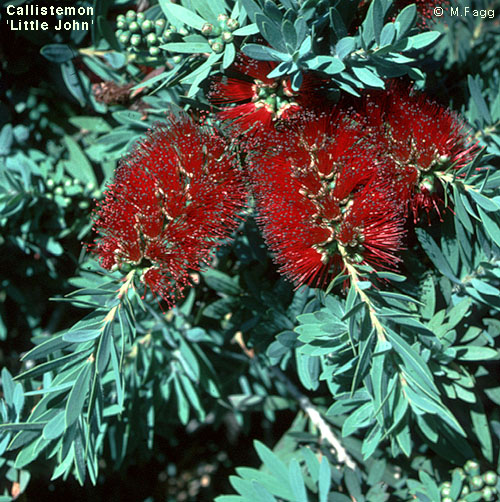 Callistemon 'Little John' is a dwarf cultivar which produces masses of flowers, and
which has blue-green foliage.
Callistemon 'Little John' is a dwarf cultivar which produces masses of flowers, and
which has blue-green foliage.
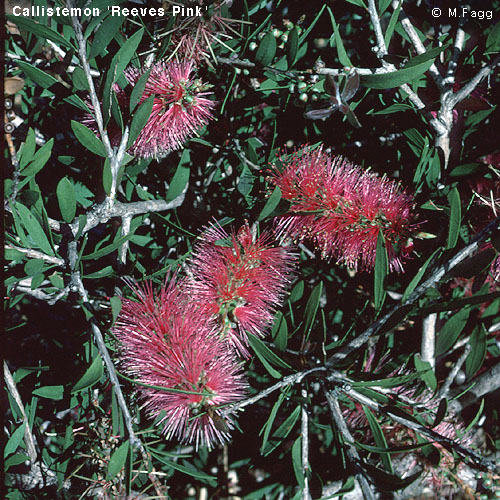 Callistemon 'Reeves Pink' and Callistemon 'Mauve Mist' produce attractive
pink flowers and grow well near a wall in cold areas and flourish in warmer
climates.
Callistemon 'Reeves Pink' and Callistemon 'Mauve Mist' produce attractive
pink flowers and grow well near a wall in cold areas and flourish in warmer
climates.