![An Australian Government Initiative [logo]](/images/austgovt_brown_90px.gif)



Westringia fruticosa
 |
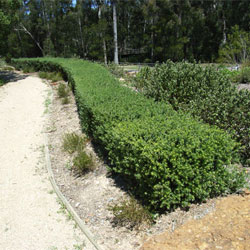 Westringia fruticosa used as a hedge |
Coastal or Native Rosemary
Westringia fruticosa (Willd.) Druce
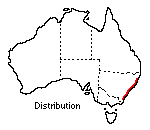
As a large permanent feature in a garden or public grounds where space is available, the Coastal or Native Rosemary (Westringia fruticosa) is an excellent choice. It is an easily grown shrub of simple and neat appearance which grows wild near the coast of New South Wales. Stretches of it are seen hugging the cliffs and down to beach level, either prostrate or several feet high depending on situation.
 White flowers dot the shapely plants. Growth is naturally stiff and bushy but
responds to garden treatment by growing much taller. lt reaches at least 2 m
high and 5 m across, often forming a regular dome with its lower branches covering
the ground. lt is useful as a large type of ground-cover plant. Sometimes it
throws out one or two main branches to develop an irregular habit, but generally
the plant is shapely. After reaching a mature size it does not deteriorate quickly
with age as some species do, but maintains a good condition for years. During
the coldest weather it keeps a fresh appearance and is also drought hardy, though
adequate water should be given to avoid tendency to yellowing leaves and bare
wood.
White flowers dot the shapely plants. Growth is naturally stiff and bushy but
responds to garden treatment by growing much taller. lt reaches at least 2 m
high and 5 m across, often forming a regular dome with its lower branches covering
the ground. lt is useful as a large type of ground-cover plant. Sometimes it
throws out one or two main branches to develop an irregular habit, but generally
the plant is shapely. After reaching a mature size it does not deteriorate quickly
with age as some species do, but maintains a good condition for years. During
the coldest weather it keeps a fresh appearance and is also drought hardy, though
adequate water should be given to avoid tendency to yellowing leaves and bare
wood.
Foliage is a dark, even green, and a covering of short hairs on the young tip growth and leaf undersides gives a silvery tint which adds to its attractiveness. Leaves are up to 2 centimetres long, narrow and pointed and set closely in whorls around the stem. Westringias are in the mint family (Lamiaceae).The name 'Rosemary' refers to the appearance of the plant only, as the leaves have not the familiar aroma, though a light scent has been noticed in the flowers in one location.
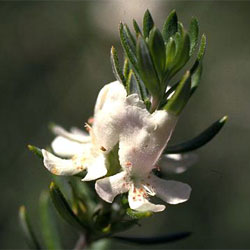
The flowers are 2 centimetres across set round the stems in the axils of the leaves. In shape they resemble other flowers of the mint family. They are from white to palest mauve with reddish and yellow brown spots near the throat. Though the shrub is never smothered in flowers, they are conspicuous against the dark foliage and are seen most months of the year except in extreme heat or cold. In November they are abundant.
Young plants raised from cuttings may be bought from nurseries and may be planted in any soil. Owing to its original habitat it is a good choice for a seaside garden, as it withstands salt spray. As a cut flower the stiff straight sprays are surprisingly handsome, especially where a large arrangement is wanted, as quite long sprays live well in water and continue to open their buds for weeks. Yet another use is as an indoor plant when it remains equally fresh in a reasonably cool atmosphere, and continues flowering.
Pests and diseases never seem to trouble this species.
Based on text by Irene Beeton (1971)
Name meaning: Westringia fruticosaWestringia - after J. P. Westring, an 18th century Swedish physician; fruticosa - shrubby, bushy. |