![An Australian Government Initiative [logo]](/images/austgovt_brown_90px.gif)



Commersonia fraseri
 |
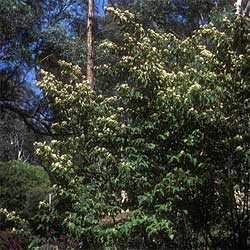 |
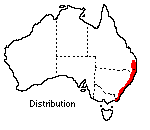
Commersonia fraseri is a member of the Malvaceae family (previously Sterculiaceae), and is found in parts of the wet eucalypt forest or fringing rain forests of Victoria, New South Wales and southern Queensland. It is a tall shrub or small tree varying in height from 2 to 5 m.
 The alternate leaves are heart shaped, sometimes lobed, and have irregularly toothed margins.
The length of the leaf hairs on the prominently veined under-surfaces gives
them a whitish appearance and provides a contrast with the mid or light green
of the upper surfaces. Leaf size is quite variable: from 5 to 20 cm in length
and 3 to 12 cm in width.
The alternate leaves are heart shaped, sometimes lobed, and have irregularly toothed margins.
The length of the leaf hairs on the prominently veined under-surfaces gives
them a whitish appearance and provides a contrast with the mid or light green
of the upper surfaces. Leaf size is quite variable: from 5 to 20 cm in length
and 3 to 12 cm in width.

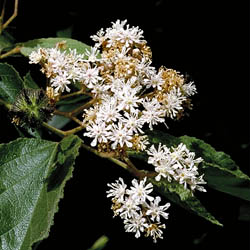
The small white flowers are massed towards the ends of the branches, in the leaf axils or opposite the leaves. The individual flowers are about 1 cm in diameter. Three conspicuous staminodes (sterile stamens) accompany each of the five white petals. The petals have a concave base surrounding the stamens and a spathe-like lamina.


In the Australian National Botanic Gardens, this plant is most floriferous during spring and summer. Plants appear to be frost tolerant.
The five-celled ovary matures to a five-valved capsule about 2 cm in diameter. Cuttings taken during winter have struck reasonably well in seven or eight weeks. In the Botanic Gardens plants have attained heights of 4 - 5 m at 6 years of age. They have suckered freely and produced an effective screen. For a more compact habit, regular pruning is advised.

Commersonia fraseri has been planted in both the rainforest gully of the Gardens and the Sterculiaceae (taxonomic) section. It has grown well in both locations, although it appears more vigorous in a moist position. Its broad leaves provide a tropical appearance and contrast with the darker tones of other foliage.
Some minor damage by leaf-eating insect larvae has been noticed on some plants. Given the knowledge of its suckering habit, Commersonia fraseri could be grown to advantage where a large-leaved, long-flowering screen plant is desired.
Text by Mark Lodder, ANBG (1980)
Name meaning: Commersonia fraseriCommersonia - after Philibert Commerson (1727-73), a French naturalist, botanist and explorer with Louis Antoine de Bougainville, on La Boudeuse and L'Etoile, 1766-59; fraseri - after Charles Fraser (c.1788-1831), a botanical collector and superintendent of the Sydney Botanical Gardens in the early 19th century. |