![An Australian Government Initiative [logo]](/images/austgovt_brown_90px.gif)



Acacia flexifolia
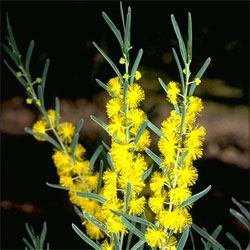 |
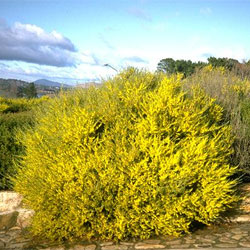 |
Small Winter Wattle, Bent-leaf Wattle
Acacia flexifolia A.Cunn. ex Benth.
The inclusion in a garden of at least some plants to provide colour during bleak winter months is an essential part of any landscape design. Acacia flexifolia , the bent-leaf wattle, is such a plant, with the added advantage that it is a small shrub. This makes it a very useful species for planting in some of the smaller spaces in the garden.
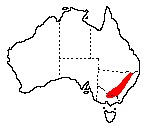
A. flexifolia occurs naturally from an area just near Stanthorpe in Queensland through western New South Wales to the Bendigo region of Victoria. The natural habitat is mainly open eucalypt woodland to whipstick scrub areas.
 This species will grow into
a shrub 1.5 m tall by 2 m across. Even where it occurs naturally the plant is
quite dense, a habit which makes it an excellent subject for gardens where a
minimum amount of maintenance is desired.
This species will grow into
a shrub 1.5 m tall by 2 m across. Even where it occurs naturally the plant is
quite dense, a habit which makes it an excellent subject for gardens where a
minimum amount of maintenance is desired.
Some specimens have glaucous phyllodes, which give the shrub a grey appearance, from a distance. These glaucous forms are good ones to select for horticulture as the grey foliage will contrast well with adjacent green foliage plants. The lemon-yellow flowers are fragrant and borne in small globular heads arising from the leaf axils. The individual flower heads are small but carried in dense profusion along the stems. The flowering season starts in May and can extend to October.
Whilst it occurs naturally in dry, sunny situations, A. flexifolia is very adaptable. At the Australian National Botanic Gardens some specimens are growing in heavy, moist soil in a semi-shaded situation yet they flower regularly each year. These shrubs, however, are showing some sparseness as they age due to the low light intensity. The best specimens can be expected from freely drained soil with plenty of light.
Acacia flexifolia has been known in cultivation for many years, though it is not widely grown. lt can occasionally be obtained from nurseries and garden centres.
The shrub tolerates pruning, which may be carried out each year after flowering. Pruning helps to keep the plant even more compact than it is in its natural habit.
Propagation is generally from scarified seed, though it is possible to grow this species from cuttings. No pests have been noted. A. flexifolia is frost and drought hardy, which is advantageous for places where supplementary watering is not always possible, for example in rural plantings. It is also a useful subject for small home gardens, as informal low hedging and for larger rock gardens.
Text by Geoff Butler
Name meaning: Acacia flexifoliaAcacia - the Greek name for the tree Acacia arabica, derived from the Greek, akis a sharp point; flexifolia - from the Latin, flexus, bent, folium, leaf. |