![An Australian Government Initiative [logo]](/images/austgovt_brown_90px.gif)



Angophora costata
 |
 |
 |
Smooth-barked Apple
Angophora costata (Gaertn.) Britten
The genus Angophora is closely allied to Corymbia and Eucalyptus (family Myrtaceae) but differs in that it usually has opposite leaves and possesses overlapping, pointed calyx lobes instead of the operculum or lid on the flower buds found in those genera.
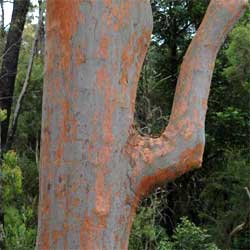
Angophora costata, or Smooth-barked Apple, is a large, wide, spreading tree growing to a height of between 15 and 25 m. The trunk is often gnarled and crooked with a pink to pale grey, sometimes rusty-stained bark. The timber is rather brittle. In nature the butts of fallen limbs form callused bumps on the trunk and add to the gnarled appearance. The old bark is shed in spring in large flakes with the new salmon-pink bark turning to pale grey before the next shedding.
The leaves are dark green, lance-shaped, 6-16 cm long and 2-3 cm wide. They are borne opposite each other on the stem.
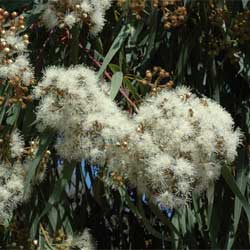
The flowers are white and very showy, being produced in large bunches on terminal corymbs or short panicles. The individual flowers are about 2 cm wide with five tooth-like sepals, five larger semi-circular petals, and a large number of long stamens. The seed capsules are goblet shaped, 2 cm long and as wide, often with fairly prominent ribs. The usual recorded flowering time is December or January, but at the Australian National Botanic Gardens in Canberra the species flowers for about one month between early January and early February. The tree has a handsome, rugged ornamental appearance and its young red tips are often used in floral arrangements.
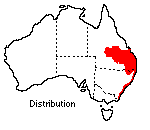 Angophora costata occurs naturally on the sandy soils and stony ridges
of southern Queensland forests, extending inland as far as the Warrego district.
In NSW it extends from Sydney northwards to the central coast and as far west
as Bathurst, being particularly common on Hawkesbury sandstone where it forms
almost pure stands. Rainfall in these areas varies between 635-1520 mm.
Angophora costata occurs naturally on the sandy soils and stony ridges
of southern Queensland forests, extending inland as far as the Warrego district.
In NSW it extends from Sydney northwards to the central coast and as far west
as Bathurst, being particularly common on Hawkesbury sandstone where it forms
almost pure stands. Rainfall in these areas varies between 635-1520 mm.
The species is grown from seed which normally germinates after seven days and no special treatment is required. The seed should be sown in a loose, well-drained mix just below the surface. When the seedlings reach a height of 1-2 cm they should be pricked out into a large container until they are large enough to be planted out.
Plants in the Australian National Botanic Gardens are doing well in a variety of situations, from well-drained rocky soils to wetter conditions. The trees differ in their growth habit, some being pyramidal with straight trunks while others have a more branching habit with twisted trunks. Most of the trees were planted in autumn 1971 and in six years had reached heights from 3-8 m.
Some trees suffer minor frost damage to new tips during winter, and caterpillars and the native leaf-cutting bee cause minor damage to the foliage. All eucalypts have an efficient method for shedding limbs, as described by Jacobs (1955). For this reason, larger species such as A. costata should not be planted so that they will overhang dwellings.
Original text by ANBG staff (1978); since updated online.
Name meaning: Angophora costataAngophora - from two Greek words, meaning 'vessel' or 'goblet', and 'to bear or carry', referring to the shape of the fruits; costata - ribbed; the capsules bear prominent ribs |
References:
Jacobs, M.R. (1955), Growth habits of the eucalypts. Timber and Forestry Bureau, Canberra.