![An Australian Government Initiative [logo]](/images/austgovt_brown_90px.gif)



Isopogon anethifolius
 |
 |
 |
Drumsticks
Isopogon anethifolius (Salisb.) Knight
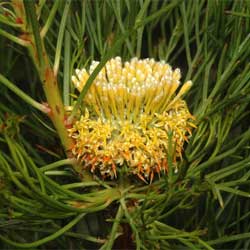
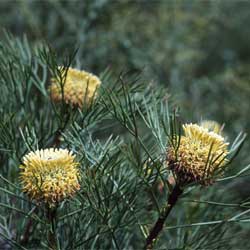
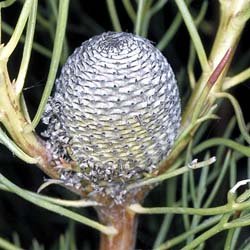
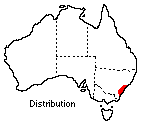
Isopogon anethifolius occurs in the coastal region and Blue Mountains of New South Wales and is one of about six eastern Isopogon species. The common name of Drumsticks alludes to the large knob-like fruits which are a feature of the bush.
 It
is an erect shrub growing to 3 m high by 1.5 m in diameter with terete (round
in section), much divided glabrous leaves to 16 cm. The bright yellow flowers
are crowded in globular heads at the ends of branches in late spring and throughout
the summer months. The fruit, of about 2.5 cm in diameter, persists on the plant
for a considerable length of time. It is attractive, both on the plant and in
floral decorations.
It
is an erect shrub growing to 3 m high by 1.5 m in diameter with terete (round
in section), much divided glabrous leaves to 16 cm. The bright yellow flowers
are crowded in globular heads at the ends of branches in late spring and throughout
the summer months. The fruit, of about 2.5 cm in diameter, persists on the plant
for a considerable length of time. It is attractive, both on the plant and in
floral decorations.
Isopogon anethifolius is hardy in Canberra, best grown in a position with dappled sunlight during summer and in a soil which drains freely. It responds well to annual spring applications of a complete fertilizer and regular deep watering at well-spaced intervals especially while it is becoming established.
Pruning may be effected by pinching out shoot tips each year, but should not be necessary beyond the early years of growth when it is desirable to form the basis of a well-branched shrub. It is usually propagated from seed.
Isopogon anethifolius can be considered a feature plant as it has year-round interest. The fine foliage and reddish stems form a useful contrast to other plants. Its dense growth habit enables it to be used as an effective screen plant. It is free from pests or diseases, being far less susceptible to root-rot fungi than many of the Western Australian species of Isopogon.
Text by ANBG staff (1978)
Name meaning: Isopogon anethifoliusIsopogon - from the Greek, isos, equal, and pogon, a beard, referring to the hairs that evenly cover the fruit; anethifolius - from Anethum, a plant of the flannel flower family, and folium, a leaf (i.e. with leaves like Anethum) |