![An Australian Government Initiative [logo]](/images/austgovt_brown_90px.gif)



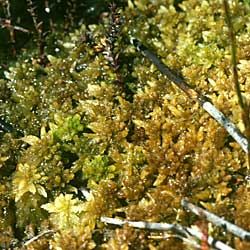
Sphagnum cristatum
 |
 |
Sphagnum Moss
The genus Sphagnum, consisting of around 250 species, is one of the most commonly-used mosses in commercial industry. It belongs to the class Sphagnopsida and order Sphagnales and is the only member of the family Sphagnaceae. Six species of the genus are known from Australia, with S. cristatum being the most common.
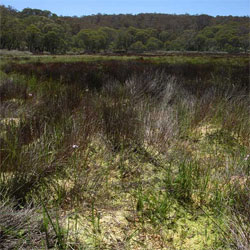
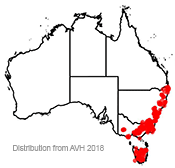 Sphagnum peatlands make up only a small percentage of the Australian landscape and are a unique and distinct environment. The main distribution of the genus is along the east coast from southern Queensland through to Tasmania. However, it is also found in tropical to subtropical areas in northern Australia, as well as in southwestern Western Australia and southern South Australia. Alpine Sphagnum bogs and associated fens, found in permanently wet sites in high rainfall alpine, sub-alpine and montane areas of New South Wales, the Australian Capital Territory, Victoria and Tasmania, are listed as a threatened ecological community under the Commonwealth Environment Protection and Biodiversity Conservation Act 1999 (EPBC Act).
Sphagnum moss is used extensively in the horticultural industry because of its super-absorbent qualities. It is most often used in the propagation of orchids, as a soil additive to promote water retention and for the long-distant transportation of rootstock. It has also been used as a surgical dressing since World War I because of its antibacterial qualities and its capacity to absorb 6 times the amount of fluid as cotton.
S. cristatum is not easily cultivated because it requires a very narrow set of conditions under which it can grow successfully. It needs a stable temperature of 23–25 degrees, regular watering from a spray system for 20 seconds every 20 minutes and a limited light intensity, so is best suited to glasshouse conditions. Sphagnum doesn't respond well to the chlorine content in tap water and should only be watered with filtered water. Soil is not required for the cultivation of Sphagnum - it can be spread thinly into plastic seed trays. Small amounts of liquid fertiliser can be applied to encourage growth but care must be taken with the application. Pest control is not needed because Sphagnum has devised its own natural defense system against insect and fungus attack by liberating hydrogen ions and creating an intolerable pH level in its immediate environment.
Limitations exist in the cultivation of S. cristatum mainly because it is very slow-growing and requires glasshouse conditions. The annual growth rate of natural S. cristatum populations is estimated to be between 0.4-4.2 cm. For these reasons some gardeners who like to see instant results may be disappointed. S. cristatum is a beautiful and fascinating plant and is well worth the little extra patience it requires to grow.
Text by Sharon Brown (2002 Student Botanical Intern); since updated online
Name meaning: Sphagnum cristatumSphagnum - from the word sphagnos, which goes back as far as the 4th century when it was used as a prescribed medication. The actual meaning of the word is thought to be 'astringent'; cristatum - from the Latin cristatus, meaning 'crested' and refers to the boat-shaped branch leaves which are wide and concave. |
References
Whinam, J. 1997. The sustainability of Sphagnum moss harvesting in Australia. Parks and Wildlife Services. Tasmania, Australia.
Richardson, D.H.S. 1981. The Biology of Mosses. Blackwell Scientific Publications, London, UK.
Seppelt, R.D. 2000. The Sphagnopsida (Sphagnaceae; Ambuchananiaceae) in Australia. Hikobia Vol. 13: pp 163-183.
Department of the Environment 2015. National Recovery Plan for the Alpine Sphagnum Bogs and Associated Fens. Commonwealth of Australia. Available online at: http://www.environment.gov.au/biodiversity/threatened/publications/recovery/alpine-sphagnum-bogs-associated-fens